Strategic Goal Method
A method for defining annual organizational goals, the Strategic Goal Method is designed for leadership teams that have a clear strategy but need a disciplined way to identify, define, and commit to the annual goals that will move the organization forward.
A strategy describes where an organization intends to go over the next two to five years. Goals define what the organization will commit to accomplishing this year in order to move closer to that destination. If you’re coming from the Strategic Guidance Framework or the Strategy Model, you have inputs that will help to define your strategic goals.
The distinction between strategy and goals is important. A strategy without goals is little more than an aspiration, while goals without strategy quickly become disconnected initiatives competing for attention. The Strategic Goal Method exists to bridge that gap by helping leadership identify, define, and commit to the annual outcomes that matter most.
Unlike some goal-setting approaches, this method does not begin by asking, “What should our goals be?” It begins by asking whether something deserves to become a goal at all.
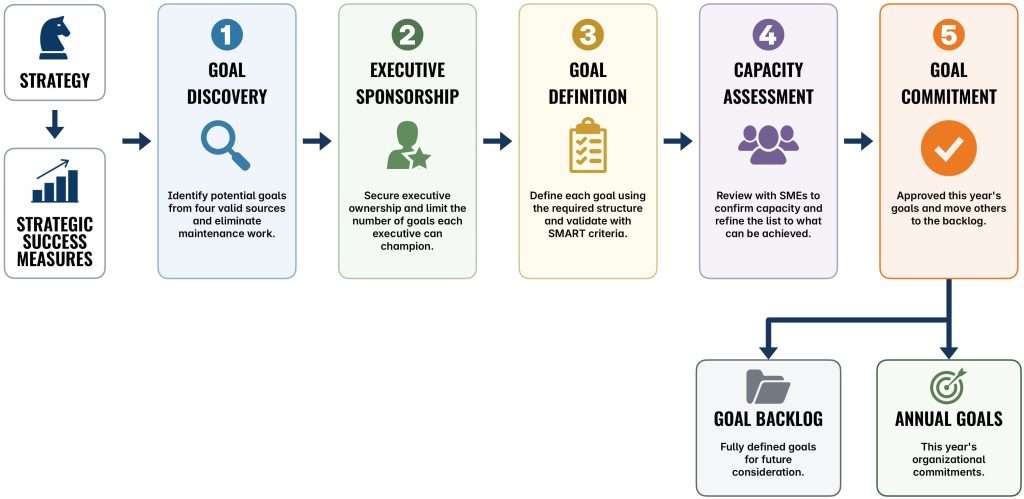
One principle sits at the heart of this method:
A Goal is an organizational commitment, not a wish list.
This cannot be emphasized enough. That commitment means a goal must be well-defined, supported by leadership, achievable within the organization’s capacity, and important enough to justify the attention it will receive throughout the year. If it cannot satisfy those requirements, it isn’t a goal. It may be a good idea, but it isn’t ready to become an organizational commitment. If the goal is mature enough, it either becomes an annual goal, or it goes into the backlog for a later time.
Sidebar: An important note at this point is that Goals may not need to be fixed annually, in the sense that they need to happen between January 1 and December 31, or linked to your fiscal year. For budgeting reasons, they often will be. But Goals should be revolving in fulfillment of a strategy. If you have nine goals, and you achieve all nine in six months, you can continue to add or set more goals, rather than relying on a strict annual pattern.
Step 1: Goal Discovery
Every goal should begin with a reason to exist. Goals should never be invented simply because leadership feels the organization ought to have more of them.
Instead, every proposed goal should originate from one of four sources:
- It advances the organization’s strategy.
- It removes a strategic barrier preventing progress.
- It responds to a mandatory change such as legislation, regulation, or industry requirements.
- It exploits a significant business opportunity.
Equally important is recognizing what does not belong here. Routine operational work, recurring maintenance, and normal business responsibilities are not goals. Maintaining ISO certification every year, renewing software licenses, processing payroll, completing annual audits, or patching routine security updates are all important activities, but they exist to keep the organization operating rather than moving it forward.
However, significant improvements may qualify. Achieving ISO certification for the first time, implementing a new cybersecurity program to satisfy emerging legislation, or modernizing a core business process all represent meaningful organizational change rather than ongoing maintenance.
By the end of Goal Discovery, every candidate should have a clear purpose and a valid reason for existing.
Step 2: Executive Sponsorship
Every goal requires an owner. Executive sponsorship is more than approval. It is a commitment to champion the goal throughout the year, remove barriers when necessary, and remain accountable for its success.
Organizations often create far more goals than they can realistically accomplish because nobody owns the responsibility for deciding what should be left behind. Similarly, if a goal isn’t adhered to, and no one is held accountable, there is little motivation to achieve goals in the future. Executive sponsorship creates that accountability.
As a practical guideline, each executive should sponsor (a formal term, but does not necessarily mean out-of-pocket) only as many goals as they can realistically lead with excellence. The exact number will differ between organizations, but leadership capacity should naturally limit the total number of annual goals.
If nobody is willing to sponsor a goal, it probably shouldn’t become one.
Step 3: Goal Definition
Once sponsorship has been established, the goal should be documented using a consistent structure. The simplest form is a single document, perhaps even a presentation slide (easier for reviewing online) containing responses or answers to six requirements. Every goal should be its own document, and easy to compare one goal against another.
Each goal should clearly define:
- Goal Statement
- Business Value
- Strategic Alignment
- Goal Success Measures
- Executive Owner
- SMART Validation
SMART should not be used to invent goals. Instead, it serves as a quality check to ensure each goal is Specific, Measurable, Achievable, Relevant, and Time-bound before leadership commits to it.
Example:
Goal Statement
Expand our commercial customer base by increasing enterprise clients by 20% during FY2084.
Business Value
Increase recurring revenue while diversifying the customer portfolio and reducing dependence on a small number of large clients.
Strategic Alignment
Supports Strategic Direction #2: Expand into higher-value commercial markets.
Goal Success Measures
- Increase enterprise clients by 20%.
- Grow recurring commercial revenue by 15%.
- Maintain customer retention above 95%.
Executive Owner
Vice President, Business Development
SMART Validation
✔ Specific • ✔ Measurable • ✔ Achievable • ✔ Relevant • ✔ Time-bound
Step 4: Capacity Assessment
Even well-written goals must be achievable. Leadership should review every proposed goal with the people responsible for delivering it. Subject matter experts (SMEs), department leaders, and delivery teams often have valuable insight into organizational capacity that may not be obvious at the executive level.
This discussion is not intended to challenge the importance of a goal. It exists to determine whether the organization has sufficient time, people, budget, and expertise to achieve the proposed set of goals within the coming year.
Sometimes the answer is that every goal is worthwhile.
The harder question is whether every goal is possible.
Organizations that consistently succeed tend to commit to fewer goals and execute them exceptionally well rather than spreading their effort across too many competing priorities.
Sidebar: This is a common time for leaders to try to redefine a goal like a project. A goal is meant to achieve an outcome, but a project is how that outcome is accomplished. SMEs and other experts should not be expected to answer how a goal can be achieved within a year, but rather whether there is potential for establishing projects that can meet the goal.
See Also: How to Assess a Goal Without Projects
Step 5: Annual Goal Selection
The final step is commitment. Leadership selects the annual goals that the organization will pursue and formally commits to delivering them during the coming year.
Not every valid goal will be selected.
The remaining goals should not be discarded. Instead, they become part of a Goal Backlog containing fully defined, fully validated goals that were simply not selected this year. As organizational priorities change or planning begins for the following year, leadership can return to this backlog knowing that each candidate has already been thoughtfully developed.
This is an important distinction.
The backlog is not a collection of unfinished ideas or future wishes. Every item has already completed the Strategic Goal Method. The only reason it was not selected is because leadership intentionally chose to focus its limited capacity elsewhere.
From Strategy to Commitment
The Strategic Goal Method transforms long-term strategy into annual organizational commitments. By requiring every goal to be discovered, sponsored, defined, capacity-tested, and deliberately selected, organizations create goals that are meaningful, achievable, and aligned with their strategic direction.
Once the annual goals have been established, they naturally lead into the next stage of the Strategic Guidance Framework: defining the quarterly Objectives that measure progress toward achieving each goal throughout the year.