Strategy Model
A thinking model for a clear strategy.
A strategy is only valuable if people can understand it, explain it, and use it to make better decisions. Unfortunately, strategy often becomes the opposite. Leadership spends days discussing the future, documents are written, presentations are given, and everyone leaves believing they have a strategy. Months later, ask five leaders what the strategy is, and you’re likely to receive five different answers.
The problem is that strategy is rarely built in a way that creates clarity and has longevity after people leave the strategy session.
The Strategy Model is designed to solve that problem.
The Model
Rather than asking leadership to simply write a strategy statement, the model guides a structured conversation that transforms purpose into direction. By the time the discussion is complete, the organization should not only have a concise strategy statement, but also a shared understanding of how it arrived there.
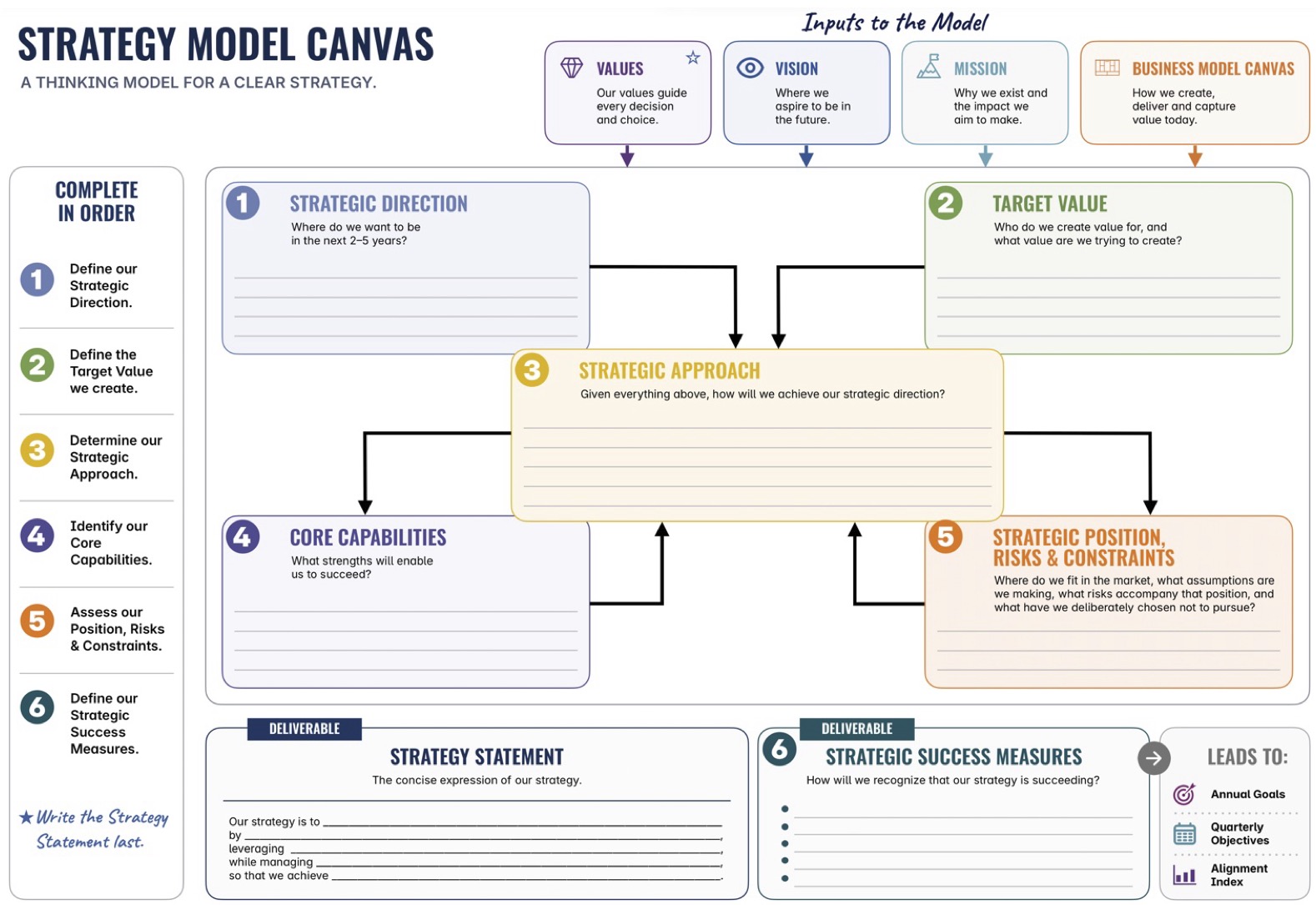
The Strategy Model builds on the organization’s Values, Vision, and Mission, together with the Business Model Canvas, if you developed one. Those artifacts provide the foundation for discussion, but they are not the strategy itself. Instead, they become inputs into a structured thinking exercise that helps leadership answer six fundamental questions, and to produce two main deliverables: a Strategy Statement, and Strategic Success Measures that provide valuable ongoing feedback to leadership. The Strategy Model Canvas, shown above, is an active worksheet that provides a visual representation of the model.
1. Strategic Direction
Everything begins by defining where the organization intends to be over the next two to five years. This should not be a list of projects or initiatives. It should be a clear description of the future state the organization is working toward, refined from its Vision and Mission.
2. Target Value
Once direction has been established, leadership defines who the organization intends to create value for and what value it intends to provide. The Business Model Canvas provides much of the thinking behind this section, while the organization’s Values help ensure the value being created reflects the character of the organization.
3. Strategic Approach
This is the heart of the model. Given the desired direction and the value the organization intends to create, how will it actually get there? The strategic approach describes the broad methods, focus areas, and choices that will guide the organization over the coming years.
4. Core Capabilities
Every strategy depends on strengths. Some capabilities already exist, while others must be developed. This section identifies the capabilities the organization will rely upon to successfully execute its strategy.
5. Strategic Position, Risks & Constraints
No strategy exists in isolation. Every organization occupies a position within its market, makes assumptions about the future, accepts certain risks, and deliberately chooses not to pursue other opportunities. Understanding those realities helps create a strategy that is both ambitious and practical.
6. Strategic Success Measures (Deliverable)
The first deliverable (something tangible that can be viewed independently) identifies the high-level indicators that will demonstrate whether the strategy is succeeding. These are not annual goals or quarterly objectives. Instead, they define what long-term strategic success looks like and provide the foundation for establishing Goals, Objectives, and, ultimately, the Alignment Index.
Strategy Statement (Deliverable)
Only after the previous sections have been completed should the Strategy Statement be written. It becomes the concise summary of the organization’s direction, expressing in a few sentences what the organization intends to accomplish and how it intends to achieve it.
From Strategy to Action
The Strategy Model is meant to help organize strategic planning. By guiding leadership through a structured conversation, the model transforms broad aspirations into a clear, communicable strategy that the entire organization can understand. Once that strategy has been defined, it naturally feeds the next stage of the Strategic Guidance Framework, where annual Goals and measurable Objectives translate long-term direction into practical execution.