
Priority Framework
This page is for leaders who feel as though their organization has clarity on direction and purpose, but find that ideas are manifesting as projects before they are mature enough to be properly managed. This issue doesn’t stem from approving bad ideas, so much as it is the result of inconsistent processing and prioritization. This is a framework for turning ideas into ready-to-implement projects.
Organizations rarely suffer from a shortage of ideas, but they definitely suffer from having too many ideas make it to the priority list, usually all listed as number one. The challenge is determining which ideas deserve to become projects in the first place, preparing them well enough that meaningful decisions can be made, and ensuring that approved projects begin with the right people, the right information, and the right expectations.
Too often, ideas move directly into implementation because they sound promising, while others spend months being discussed without ever becoming actionable. Neither approach serves an organization well. Good ideas deserve thoughtful evaluation before they consume time, money, and resources.
The Priority Framework provides a structured approach for moving an idea from initial concept to a project that is fully prepared for implementation. Rather than treating prioritization as a single meeting or scorecard, the framework recognizes that good prioritization depends on good preparation.
How It Works
The Priority Framework consists of connected stages and models.
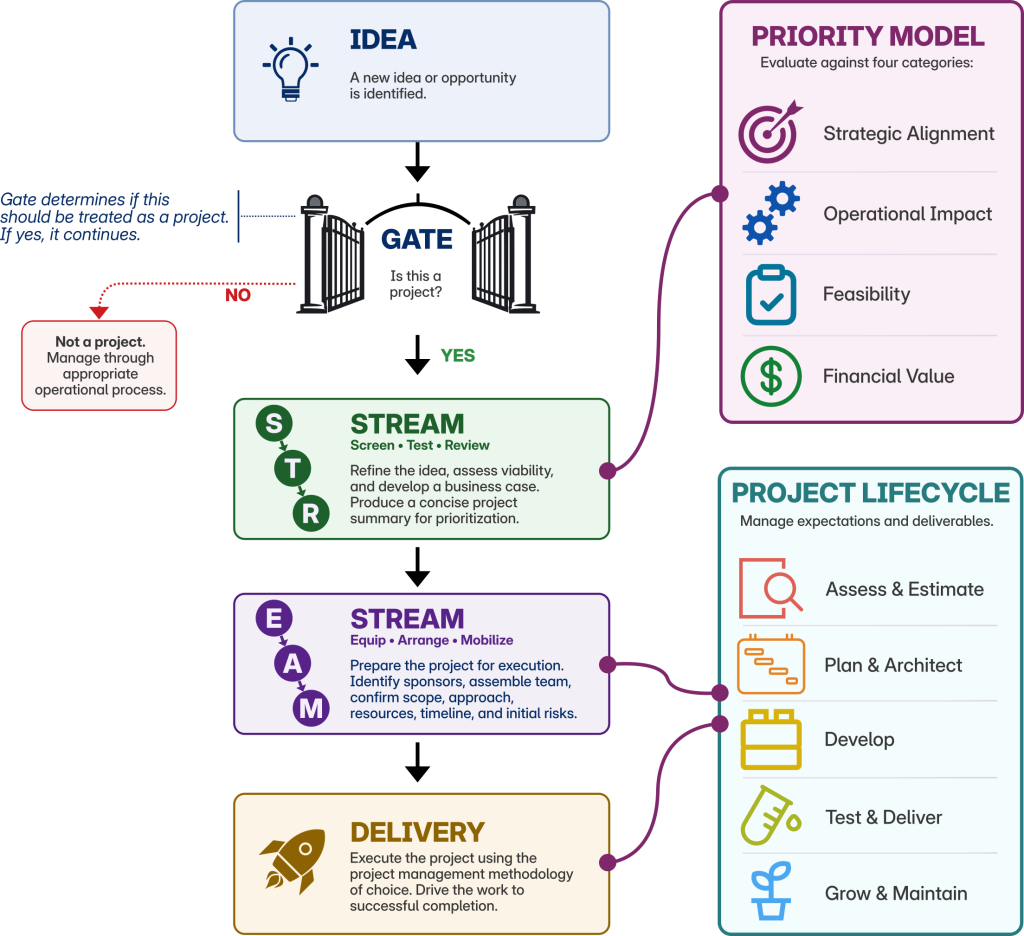
Beginning with an idea, the first step is to determine whether this constitutes a project, or just business-as-usual activity.
Gate
Is this actually a project?
Many requests are operational improvements, routine maintenance, policy changes, or day-to-day work that should never consume the overhead of formal project management. Gatekeeping prevents organizations from creating unnecessary projects while ensuring that significant initiatives receive the attention they deserve.
If the answer is yes, the initiative enters the STREAM Process.
STREAM: Screen, Test, Review
The first half of the STREAM Process focuses on understanding the idea.
Rather than jumping directly into planning, the goal is to determine whether the idea solves a meaningful problem, can be clearly defined, and is supported by enough information to justify further investment.
By the end of these three steps, the organization should have a concise project summary, strategic business case, or similar document that explains the opportunity in enough detail for leadership to evaluate it objectively.
The evaluation allows the organization to prioritize, and add the project to the roadmap.
Priority Model
Once the opportunity has been defined, it can be evaluated consistently and objectively.
The Priority Model scores initiatives against four areas:
- Strategic Alignment
- Operational Impact
- Feasibility
- Financial
Rather than relying on opinion or the loudest voice in the room, projects are evaluated using the same criteria every time. The resulting score helps determine relative priority while still allowing leadership to apply judgment where appropriate. Prioritization doesn’t replace leadership decisions, it provides a consistent foundation for those leadership decisions.
STREAM: Equip, Arrange, Mobilize
Once an initiative has been approved, the second half of the STREAM Process prepares it for execution.
Project sponsors are identified. Team members are engaged. High-level deliverables are established. Initial timelines and risks are discussed. Expectations are clarified before implementation begins.
The objective is simple: by the time a project reaches implementation, the team should already understand what success looks like and how they intend to achieve it.
Delivery
With preparation complete, the project enters execution using the organization’s project management methodology of choice.
Whether that is Agile, Waterfall, hybrid, or another approach is less important than ensuring the project remains aligned with the strategy, goals, objectives, and priorities established before work began.
Successful delivery is rarely determined by the project management methodology itself. More often, projects struggle because priorities change unexpectedly, resources are diverted to competing work, or communication breaks down between stakeholders.
People know how to get the job done. They don’t know how to react or respond when the job they’re paid to do is constantly derailed from their course.
Organizations that maintain clear strategic direction, disciplined prioritization, and regular review of goals and objectives are far more likely to deliver successful projects regardless of the methodology they choose.

For software projects specifically, the framework of Software Project Management for Everyday Business is an excellent starting point, combined with its corresponding book.
From Ideas to Action
The Priority Framework recognizes that prioritization is not a single event. It is the result of a deliberate progression from idea, to evaluation, to preparation, and finally to execution. By separating those activities into distinct stages, organizations make better investment decisions, begin projects with greater confidence, and reduce the likelihood of valuable initiatives being delayed, misunderstood, or abandoned before they have the opportunity to succeed.
At every step along the way, your teams will struggle with constantly competing priorities. Knowing how prioritization happens, and being active in the process helps to ensure that everyone can manage themselves within changes.