Priority Model
A model for evaluating projects objectively.
The Priority Model provides a consistent way to evaluate and compare potential projects before they become organizational commitments. Rather than relying on opinion, urgency, or the loudest voice in the room, the model encourages structured discussion around the factors that matter most to the organization.
The model is organized into four evaluation categories:
- Strategic Alignment
- Operational Impact
- Feasibility
- Financial
Each category contains one or more evaluation criteria that are scored independently. Organizations may choose to weight individual criteria differently depending on their priorities, allowing the model to reflect the realities of their own business while maintaining a consistent decision-making process.
Further, criteria within categories can be changed to suit specific company needs. Once criteria is set, it’s wise to leave it for the duration of your strategy. This way, any project can be objectively compared to the company strategy, allowing objective scoring to remain consistent. Although the model can be expanded to include additional criteria, four categories with three criteria per category is generally sufficient, as this provide 12 points of assessment for priority.
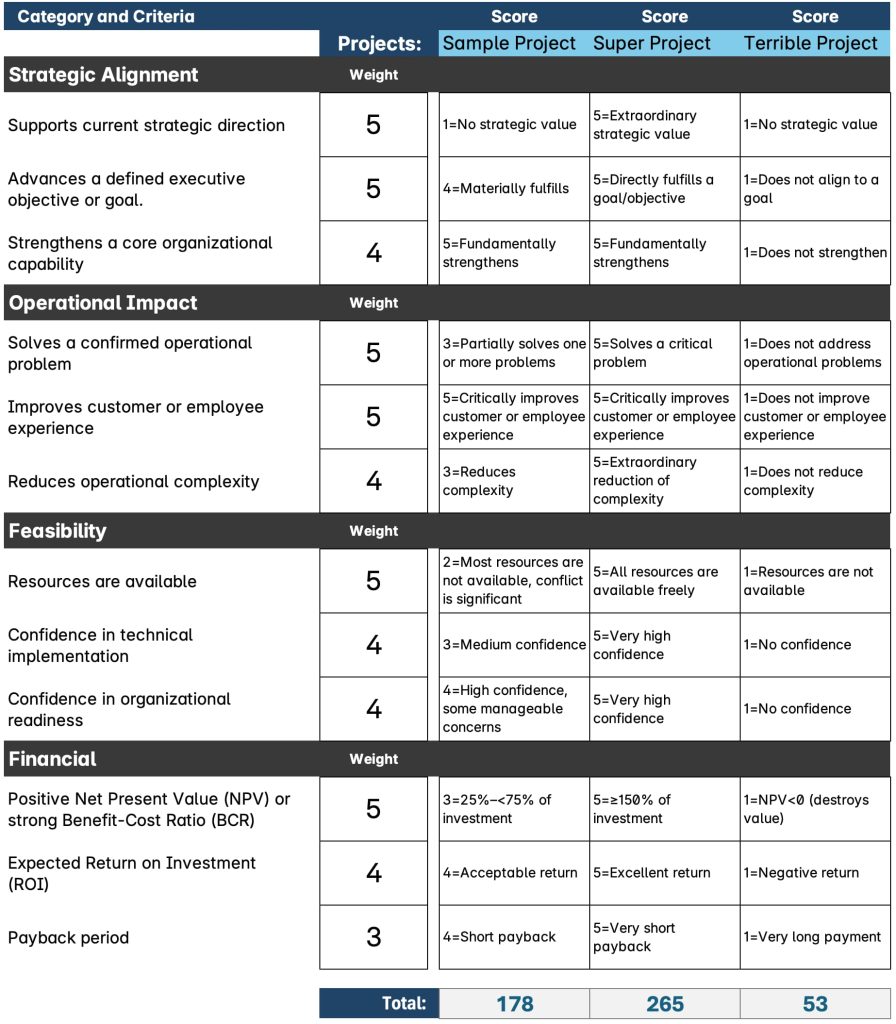
The above example is a spreadsheet that allows you to assign a priority score to any project. The categories and criteria are shown with a weighting that identifies how important that criteria is to the organization. The criteria shown above can be generally accepted as-is, or modified for an organization’s specific needs. The score for each project, as shown with the three project examples above, is multiplied against the weight, and produces a total identifying the project’s total score.
- No score for every project equals zero, resulting in a total score of 0.
- The lowest possible score will be the “Terrible Project” which scores a 1 in every criterion, multiplied by the weight, resulting in 53 which is the lowest weighted score.
- The highest possible score will be the “Super Project” which scores a 5 in every criterion, multiplied by the weight, resulting in 265 which is the highest weighted score.
- If the weighted values were all 5, the highest score would be 5 (weight) x 5 (score) x 12 (criterion) = 300.
This structure ensures that even with a large number of current or potential projects on the go, it’s easy to quickly rank them and identify the project sequence: prioritize the project with the highest score first.
This model is intentionally flexible. Scores may be assigned by a single decision maker or, more commonly, through a group of stakeholders such as an executive team, governance committee, or project review board. Individual opinions become normalized into a single result, helping reduce bias while ensuring every voice has an opportunity to contribute.
The Priority Model is not intended to determine whether a project should exist. That decision is made earlier through the STREAM Process.
Instead, it answers a different question:
Given all of the projects that deserve consideration, which ones should receive attention first?
When used consistently, the Priority Model creates transparent, repeatable prioritization decisions that align project investment with organizational direction rather than individual preference.