
The Data Factor
Can you trust your data?
Turning ideas into tangible and actionable projects is the essence of building a good business operation. Using The STREAM Process is a great way to identify whether an idea has enough merit to be actionable. The Priority Model identifies when the project should be done, relative to other projects and plans. But how do you know if your idea or concept can even be trusted in the first place?
The first step in the STREAM process is to screen the idea, answering three questions: Does it solve a critical problem or fulfill a genuine business need? Will it deliver measurable benefits? Can those benefits be repeated or expanded over time?
One of the challenges at this initial vetting stage is that sometimes people lie.
And, sometimes the data lies.
Not necessarily out of direct and malicious intent, or out of bad data, but definitely out of ignorance or misunderstanding. Ask five different people in the company, “what constitutes a sale?” and you’ll get five different answers. Each person is communicating the truth as they understand it. But the truth, depending on perspective, may be subjective instead of objective, and you need a clear identifier on the reliability of data to objectively decide, does this solve a problem, yes or no… does this deliver a measurable benefit, yes or no… and can this benefit be repeated, yes or no.
So how can you know? Similar to the Priority Model, data used in planning and decision-making can also be categorized on a scale of 0 to 5, to assess the reliability of your data source. What’s the difference from 0 to 5? Simply, 0 is what people say, and 5 is what people do. Because words can be wrong, but actions, as they say, speak louder than words.
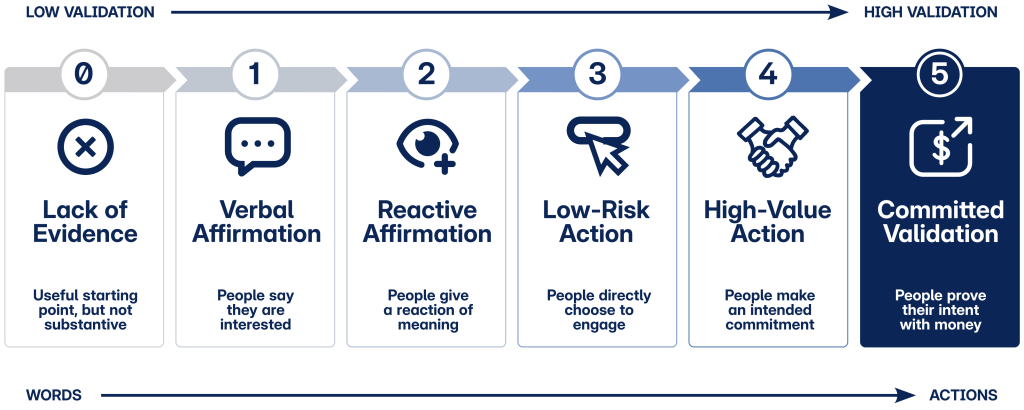
On the above diagram, your data can be evaluated on a scale of 0 to 5. Higher validation should get more attention than lower validation. But this doesn’t mean your data is a problem if your validation is low, it just means you need to improve the validation. Each of the descriptions below shows you how to move up one level in your validation. From Lack of Evidence to Verbal Affirmation, from Verbal Affirmation to Reactive Affirmation, and so on.
Reliability 0 – No evidence
A reliability of zero is one of the hardest to admit. What do we have to back our proposal?
- Projections from historical data
- A pro forma, business plan, strategic plan, or spreadsheet
- Trends, analysis, and high level market research
If these are the pieces of evidence that you have to justify your project or idea, this is the hardest to accept that you actually don’t have evidence. Projections are possible, maybe even likely, but unless your project idea is to just sell more of what you already have, this isn’t real evidence. A business plan isn’t a tangible result. It’s a good start, but you need more.
So what’s the first thing you should do if your reliability is at zero? Start with at least a survey. That moves you one step ahead.
Reliability 1 – Words Alone
So much better than “no real evidence at all” is the first level of data reliability that matters: what people say. This can come from surveys, feedback forms, or customer interviews. Quite simply: ask people directly what they want.
Does your idea meet their request? Good! You’re on the right path. But, it doesn’t matter if you survey 5 people, or 500 people… you still only have their word to rely on.
So what can you do to make your reliability of data move higher? Discover more, and shift people from what they say to how they react. Because reactions are more powerful than words.
Reliability 2 – Reactions
There’s an old saying that “the body doesn’t lie.” It’s meant to convey that when words say one thing, the body will often communicate something deeper. It’s one thing to say you’ll do something, but it’s another thing entirely when your reaction to something confirms what you say.
After doing a customer interview or discovery session, getting a reaction from people helps to make the data more reliable. Rather than pitching an idea, present something tangible. It doesn’t have to be your product, but it has to be more tangible than just your words or your spreadsheet. A brochure, a pamphlet, a prototype, anything that can invoke a reaction beyond simply words to words. When your customers can react directly to your ideas, you can trust that data more than just relying on their verbal feedback.
What does it take to make the reaction more proactive? It’s great if they love your product idea, but will they do more than just react positively? Will they actually give something up to receive what you’re offering?
Reliability 3 – Low-Risk Action
A reaction can help gauge the legitimacy of a customer’s words, but a low-risk action can solidify their stance. This is the tipping point where your data changes from passive to active, and where you have potential for customers to make decisions based on what you offer.
A low-risk action includes things like voluntary feedback, signing up for mailing lists, subscribing (paid or otherwise) to passive content, engaging in a digital call-to-action or proactively acting on tangible material. If you have an online form with a sign-up for your customers to receive more information, or a physical flyer with a QR code to scan for more information, this is significantly more than just hearing their words or interpreting their reaction. With words and reactions, they don’t need to commit anything. They can remain anonymous. They can tell you what you want to hear. But as soon as they need to surrender personal contact information, or actively request a connection, they are now acting of their own accord—albeit with potential reluctance, as they can continue to opt-out—but reaching this point matters!
How do you turn that low-risk action into a meaningful, reliable source of data to validate what you’re about to do? Change the low-risk action to increase the stakes.
Reliability 4 – Meaningful Action
Meaningful action is when a customer’s passive or low-risk activity changes to a stronger commitment. This is the kind of action that produces a letter of intent, an agreement to move ahead, a contract or commitment to proceed further.
These are gold. Respect them. The customer has decided, and they’re ready for the next step. You’ve done the hard work getting here, and the last step—the transaction—is the part you can’t afford to mess up, because that last step is the full conversion.
How do you turn commitment into revenue? Make whatever you offered real, or real enough to matter.
Reliability 5 – Live Experiments
You don’t need to have a real product to see real revenue potential. Kickstarter is a great example of this. The pledge is a level 5 data model. How do you know the project is a good idea? Because 500 people sent money to make sure it is. Having 500 people give feedback that they’re interested is only level 1. Those same people signing up for two-way engagement on topic is level 3. But 500 people pledging real money? That’s level 5.
You don’t need to have the actual product yet. You just need a solid, tangible, and usually financial commitment from real customers to know that your data is valid.
So now what? What do we do with that information? Well, if you’re working through the STREAM process, and you have only level 0 data, spend more time getting data before going any further. If you have level 1 or level 2 data, move it ahead and prioritize your project, but validate your data before you actually start it. This way, if attempts to qualify the data prove that it’s less reliable than you thought, you have the opportunity to adjust your Priority Model scoring based on the ROI, NPV, or feasibility of your project.
But if you have those golden tickets, so to speak, of data that’s level 3, 4, or 5, then you have something viable that’s worth pursuing. Knowing that you have customers ready and waiting, especially if they’ve already committed funds to make it happen, your priority model qualifiers are suddenly more clear:
- It improves the customer experience, delivering something they’ve paid for.
- It validates making resources available.
- It increases confidence in technical implementation, especially if there are funds to back the work.
- It has a positive net present value (NPV) or a strong benefit-cost ratio (BCR)
- It has a viable ROI
- It has a shorter payback period due to higher market acceptance
Your priority model may still prioritize the project lower, based on magnitude of effort, or overall value to the company. While in most cases, a customer “ready and waiting” is the most desired state, the reality is that a customer that is ready and waiting for a product you simply don’t have the capacity to fulfill is a bad thing, not a good thing. If you manufacture office stationery, but your customers are ready to pay for you to make fresh bagels, that’s great data to have, but not necessarily aligned with your company’s purpose.
Trusting your data is only one part of the equation, but it can help to ensure that the STREAM Process and the Priority Model can be used objectively, without your executive team debating the legitimacy of the data repeatedly.
As Marcus Aurelius said, “Waste no more time arguing what a good man should be. Be one.” With data, the same is true: Waste no more time arguing what good data actually is. Just go get it.