
Roadmap Model
There are many ways to represent a business roadmap, but the simplest is to show a timeline of projects and goals for the foreseeable future. As projects are added and removed, your roadmap is revised, but always serves as a guide so that your teams can see a bigger picture.
A roadmap connects strategy to execution by showing what projects the organization intends to complete, when they are expected to be delivered, and which goals they support. It provides a clear view of organizational direction without becoming a detailed project plan.
An organization’s values help to shape its vision and mission. A strategy helps to define goals and objectives. A roadmap provides cohesiveness to projects and tactics or personal plans.
So what makes a roadmap into a “model”? A roadmap is some form of visual representation of your plans. It can be simple or complex, text-based, or heavily visual. Lean towards whatever you are able to maintain, as long as you meet the basic components of a roadmap that ensures you can keep its relevancy up to date, and the visual representation appropriately maintained.
That’s all a model needs to do. Establish some guidelines for what’s needed, a visual that’s supported, and a representation that can be communicated easily.
An effective roadmap only needs to communicate three things:
- Projects — The grouped work effort (bundled deliverables) that the organization intends to deliver.
- Sequence — The general order and timeframe in which those projects are expected to be completed.
- Goal Alignment — The annual goal or goals each project supports.
A roadmap is not intended to show every task, dependency, milestone, or resource assignment—only the ones that represent significant milestones, objectives, or goal-centric accomplishments. Those belong within the organization’s project management methodology. Instead, the roadmap provides a strategic view that helps leadership understand how individual projects contribute to broader organizational objectives.
There are two common ways to show a roadmap: data-driven, like a Gantt chart, or visualized like an actual road. The first is the easiest to maintain, using project data like deadlines. The second is well-suited to marketing and design folks who are able to design something more visually appealing, which can be helpful in formal annual reports or company town halls.
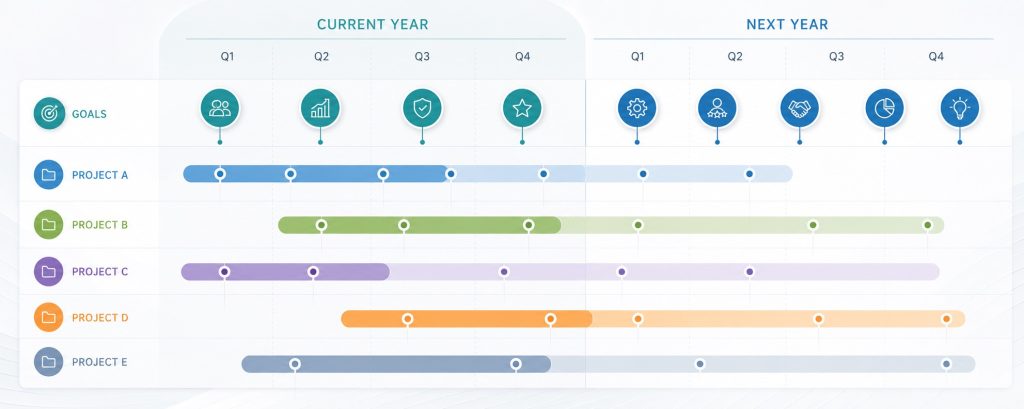
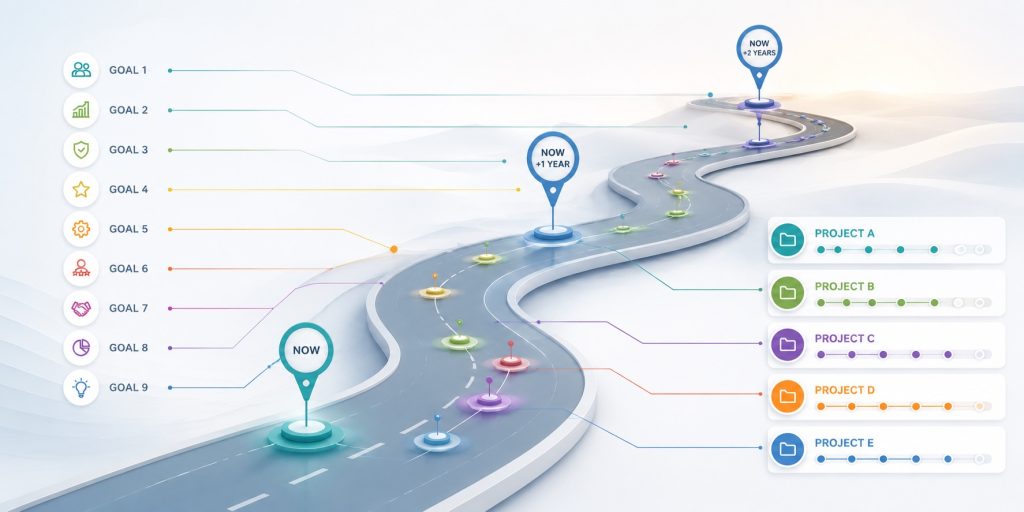
The specific roadmap style you use generally depends on tools you have available, combined with design or visual representation experience. But it doesn’t need to be complicated. A basic roadmap can be represented in a spreadsheet, using the project list from your priorities scorecard, and a small amount of effort resizing some shapes and indicators. Updating the roadmap as each project is completed, or when a goal is met, with “quarterly” being the minimum frequency, is generally sufficient.
Roadmaps should evolve as priorities change, but those changes should be deliberate. New projects should enter the roadmap through the Priority Framework, while completed projects should demonstrate measurable progress toward one or more organizational goals.
A well-designed roadmap answers a simple question:
What are we doing, when do we expect to do it, and what goals are being met?
When that answer is clear, projects become more than isolated initiatives—they become visible steps toward achieving the organization’s strategy.