
Strategic Guidance Framework
A Framework for Defining Organizational Direction: A practical approach for helping leadership teams define a clear strategy, establish meaningful objectives, and create measurable goals that give the entire organization a common direction.
Ask almost any company that has been around for a decade or more for their mission, vision, and values, and they’ll dust off a poster somewhere and show it to you. Some may even have them memorized. If you asked them, “what does your company do?” they can point to this for the answer. But if you ask them what they’re trying to accomplish over the next two to five years, or what success will look like this year, they’ll probably mumble something about priorities, and increased sales, and maybe improving culture.
One of the most common questions when working with companies on these topics is, “what is our strategy?” and almost every one of them can’t answer it. They might have a strategy document somewhere, or a loose plan they’ve been working on, but all too often, there’s no formal definition of what it is.
The OPSE Model establishes the organization’s purpose through its Values, Vision, and Mission. Those elements explain why the organization exists. The Strategic Guidance Framework extends that by helping leadership define what the organization intends to accomplish and how progress will be measured.
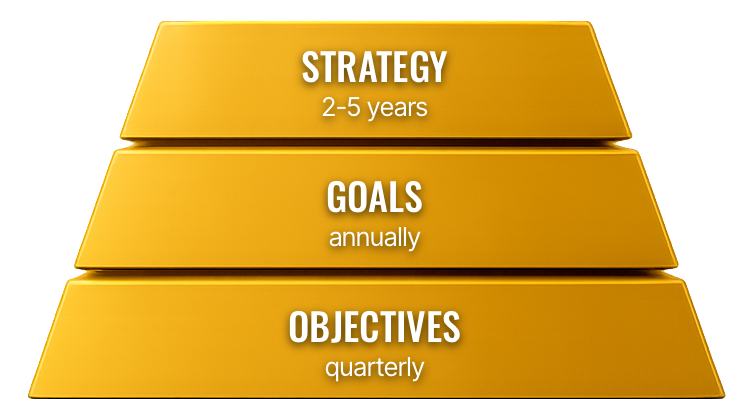
Rather than treating strategy as a one-time planning exercise, the framework organizes direction into three connected layers:
- Strategy (2–5 years)
- Goals (Annual)
- Objectives (Quarterly)
Each layer builds on the one before it (visually downward on the strategy pyramid, not structurally like a building), creating a practical path from long-term intent to measurable execution.
Tier 1: Strategy
What will we do to fulfill our Mission?
Strategy establishes the organization’s long-term direction. It should describe the major areas of focus over the next two to five years without becoming a project list.
A good strategy should be stable enough to survive quarterly changes while remaining flexible enough to adapt to significant market shifts.
Optional Model: The Business Model Canvas by Alexander Osterwalder and Yves Pigneur is an excellent starting point for understanding where a business currently operates and how. This model defines key resources, partnerships, and activities and how they fit into value propositions that use relationships and strategic channels to reach various customer segments, and ultimately to drive revenue and costing decisions. This canvas is not the strategy itself, but because it forces leadership to examine customers, value, operations, partnerships, and financial viability before declaring a strategic direction, it’s an excellent first step to defining a working strategy. Several components on the Business Model Canvas can help to make strategy definition easier.
Strategy Model: The Strategy Model and the corresponding Strategy Model Canvas expands on an organization’s Values, Vision, and Mission (and any relevant information from the Business Model Canvas if applicable) to define a 2–5 year strategy. This model provides a walk-through defining:
- Strategic Direction
- Target Value
- Strategic Approach
- Core Capabilities
- Strategic Position, Risks & Constraints
- Strategic Success Measures
Ultimately for the purpose of getting to a single Strategy Statement that is meant to encapsulate your two to five-year strategy. Facilitating this for your team is best done with the Facilitator Guide, combined with the Strategy Model and the Strategy Model Canvas.
Tier 2: Goals
What must we accomplish this year?
Goals translate strategy into annual outcomes. Unlike strategy, goals should be specific enough that leadership can evaluate meaningful progress throughout the year while remaining broad enough to allow multiple initiatives to contribute.
Goals can often be defined interchangeably in organizations with other terms like objectives, targets, OKRs (objectives and key results), and other terms. Here we define a goal as a commitment to an outcome that the business establishes. It is not a wish list or a to-do list, it is a confirmed and solid list of committed results that are in service to the strategy. Some goals may deviate from the strategy, for matters such as legal compliance or governance issues, such becoming compliant in a legal area by a particular deadline.
Goals should identify a clear value to the organization, with a purposeful statement, clear business value, alignment to the strategy, success measures, an executive owner, and validation criteria. The validation criteria is especially helpful as it helps to ensure that a goal is actually a goal. If it’s not SMART—Specific, Measurable, Achievable, Relevant, and Time-bound—it isn’t a goal.
The Strategic Goal Method is a process for defining annual organizational goals. It’s designed for leadership teams that have a clear strategy (from Tier 1 above) but need a disciplined way to identify, define, and commit to annual goals that will move the organization forward.
Tier 3: Objectives
How will we measure progress?
Objectives represent the measurable checkpoints that demonstrate whether goals are being achieved. They should be reviewed frequently, adjusted when necessary, and communicated consistently throughout the organization.
Rather than becoming another reporting exercise, objectives should become part of leadership conversations. If leadership cannot answer whether objectives are on track, the organization is operating on assumptions rather than evidence. Objectives should naturally incorporate KPIs where appropriate, but they should also encourage discussion about risks, opportunities, and changing business conditions.
Where goals are a specific outcome that businesses expect to accomplish in a year, objectives are the measures needed to ensure those goals are achieved. In a short example, a goal to increase sales by 20% in the next year, may translate to three distinct objectives to raise prices 5%, increase customer purchase-rate by 8%, and acquire 7% more customers.
Creating objectives does not need as much effort or commitment as a strategy or goals, but it does require leaders to regularly review and ensure that work effort is working towards the goals, using objectives as milestones.
The Strategic Objectives Method helps leadership define meaningful checkpoints that provide evidence the organization’s annual goals remain achievable. It focuses on the results that demonstrate the work is having the intended effect, rather than on the work being performed.
Outcomes: Working Together
The three tiers are intentionally connected. Strategy answers where the organization is heading. Goals define what success should look like over the coming year. Objectives measure whether progress is actually being made. Together, they create organizational direction that can be understood by executives, managers, and teams alike.
Using the Strategic Guidance Framework, organizations can be expected to produce three key artifacts:
- A 2-5 Year Strategy Model
- One or more annual company goals (one document per major goal)
- Multiple company objectives for the year, mapped at least quarterly
Relationship to the OPSE Model
The OPSE Model (“Model”) defines the complete organizational picture addressing Purpose, Strategy, and Execusion. The Strategic Guidance Framework (“Framework”) focuses on the the middle section of that picture by providing practical methods for defining Strategy, Goals, Objectives. If an organization already has clarity in these areas, the Model serves to help organize that clarity into a consistent structure that can be used with other systems. If an orgnization does not have clarity, this Framework helps to build it, by focusing primarily on the most common area that is poorly defined: the strategy, goals, and objectives.
If your organization doesn’t have values, vision, and mission defined, you can organize a one-day retreat with your leadership team, and there’s a good chance, without any counsel or support, they’ll likely be able to produce that material in a usable form. These three items aren’t usually difficult.
What is difficult is achieving them.
And the root cause is almost always an inability to convert vision and mission into a tangle form, through a strategic roadmap and projects. The reason this is usually difficult is that most companies struggle with strategy, goals, and objective definitions. Companies with only a dozen or two employees, and companies with thousands of employees still struggle with defining strategy, goals, and objectives. As a result, roadmaps and project implementations lack direction, and consistently produce inconsistent results.
Once direction has been established, mature ideas can enter the Priority Framework, where they are evaluated, prepared, prioritized, and eventually delivered.