Peter Drucker is often quoted as saying:
“Whenever you see a successful business, someone once made a courageous decision.”
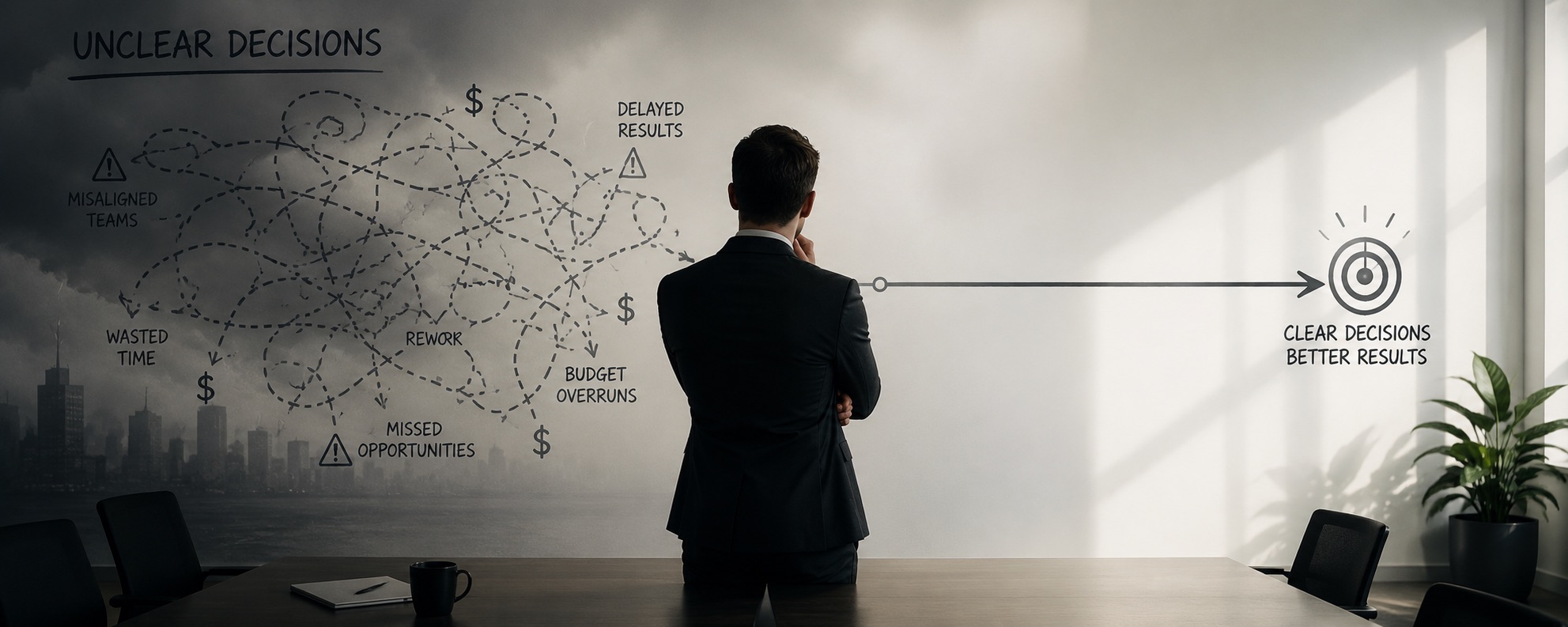
Every organization is the result of a series of decisions. Some are small, while others define the direction of the business for years to come. What separates effective organizations is rarely the number of decisions they make, it’s the clarity behind them. Clear decisions create momentum. Unclear decisions create hesitation and uncertainty. And that hesitation has a cost.
When leaders aren’t certain about the direction of the business, projects continue without a shared purpose. Teams interpret priorities differently. Meetings end with more discussion than action. People work hard, but not always toward the same outcome. Over time, progress slows, not because people have stopped working, but because they’re no longer going in the same direction.
McKinsey has found that decision-making consumes an extraordinary amount of management time—up to 70% for some managers—making the quality and clarity of those decisions one of the most important factors in organizational effectiveness. (McKinsey & Company, p54)
Many people wonder why it’s so difficult to get things done in business today, despite seemingly endless meetings and emails. Why does it take so long to make decisions—and then not necessarily the right ones? With today’s opportunities to connect and exchange, be it through email, Slack, or various videoconferencing systems, a myriad of inefficient and often unneeded interactions have been created. McKinsey research shows, for example, that decision making takes up a huge proportion of managers’ time—as much as 70 percent of it for some C-suite executives. ~McKinsey
That should not be surprising.
Every decision influences the next one. An unclear objective leads to unclear priorities. Unclear priorities lead to competing initiatives. Competing initiatives spread people and resources across too many objectives. Eventually, the organization becomes busy without becoming more effective.
Steve Jobs understood this well when he said:
“Deciding what not to do is as important as deciding what to do.”
Choosing what not to pursue requires clarity. Without it, every opportunity feels worthwhile, every project appears urgent, and every request competes for attention.
One of the greatest hidden costs of unclear decisions is that organizations often try to solve the symptoms instead of the cause. While this may provide short-term relief, what we often refer to in software as a “Band-Aid solution”, it rarely replaces the need for a clear decision about where the organization is trying to go.
Leadership teams need to pause before asking, “What should we do next? What’s our next priority?” and instead, ask, “Have we clearly defined what success looks like? Do we know what our end goal is supposed to be?”
The answer to that question changes every discussion that follows.
Clarity gives people confidence to make decisions without constant approval. It helps teams recognize which opportunities support the organization’s direction and which ones create distraction. It allows resources to be invested intentionally rather than reactively.
This won’t guarantee that you will eliminate difficult choices, but it will make those choices easier to evaluate.
The longer an organization operates without clarity, the more expensive uncertainty becomes. Time is lost. Resources are diluted. Momentum slows. None of those costs appear on a financial statement, yet they influence almost every measurable outcome in the business.
Before searching for a better system, a better process, or a better plan, make sure you’ve answered the most important question first:
Where are we trying to go?
Everything else becomes easier to evaluate once that answer is clear.