
Ask a group of employees what their company does, and you’ll probably hear similar answers. Ask them why the company exists, and the answers often become much more interesting. Some will describe the products they build. Others will talk about customers. A few may mention growth or profitability. Occasionally, someone will pause for a moment and admit they aren’t really sure.
That uncertainty matters more than many organizations realize.
People naturally want to follow something that has direction. They want to know what the organization believes, where it is going, and why their work contributes to something larger than today’s task list. Those ideas begin a lot higher than just “strategy.”
I find it helpful to think of an organization’s model as a pyramid. The full pyramid is referenced on the OPSE Model, but the first area of focus addresses why the organization exists. The “why” is what helps to create an organization worth following:
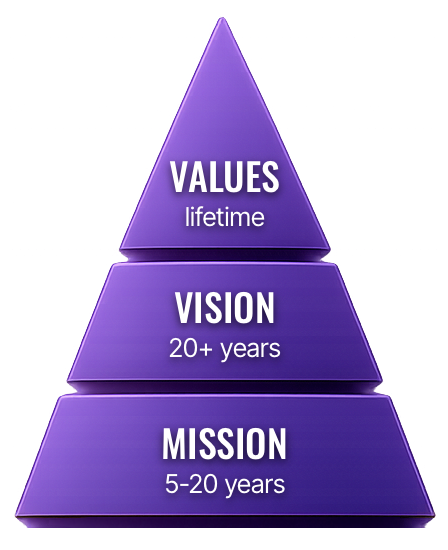
At the very top are the organization’s values. Values define who the organization chooses to be. They influence behavior when policies don’t provide an answer and when difficult decisions require judgment rather than procedure. Values should remain remarkably stable—for a lifetime, even—because they represent the character of the organization, not the circumstances surrounding it. Values should be first, because everything you do as a company should be rooted in a consistent set of values that may improve over time, but should not fundamentally change.
Just below values is vision. Vision answers a simple question: Why are we doing what we do? A good vision gives people something worth pursuing. It should be ambitious enough to inspire people while remaining believable enough that they can see themselves contributing to it. Simon Sinek popularized a similar idea in Start With Why, arguing that people are inspired by purpose before products. That principle applies just as much to employees as it does to customers.
Mission builds on that vision by describing what the organization intends to accomplish. If vision provides the destination, mission begins describing the journey. It gives leaders a common reference point when opportunities appear and difficult choices have to be made.
Those three ideas—values, vision, and mission—form the guideline for everything that follows. When an organization doesn’t have a strong set of values, is lacking a clear vision, and doesn’t have a mission to work towards, the people become disconnected, and the organization starts drifting.
Projects continue, meetings continue, budgets continue, and people continue working hard. But not necessarily towards the same goals or objectives. The connection between today’s work and tomorrow’s destination slowly fades.
I’ve seen organizations spend months debating technology, reorganizing departments, or launching new initiatives before taking the time to agree on who they wanted to become.
But creating an organization worth following isn’t just about writing a better mission statement, or having a nice catchy vision to print on posters and hang on the walls.
It’s about creating enough clarity that people can make good decisions without waiting for permission every time something unexpected happens. It’s about establishing guidelines and expectations that when uncertainty happens, everyone can point to a value, a vision, or a mission and say, “this idea isn’t us! This isn’t who we are!” When shared values are understood, behavior becomes more consistent. When vision is clear, priorities become easier to establish. When a mission is well-defined, strategy has something meaningful to support. And that’s when people get behind it.
The strongest organizations I’ve worked with have one thing in common: people throughout the organization can explain where the business is going and why it matters. Everyone from the CFO to the receptionist, from the marketing director to the shipping coordinator, from the head of sales to the custodial stuff. Everyone, and I mean everyone, gets is and knows why they’re there. I won’t reveal the company name or the mission statement for confidentiality reasons, but in one organization I was with, the CEO asked a custodial member, “what are you doing?” The question wasn’t accusative or trying to investigate a problem, it was simply a question asking a human being what their work is all about. That person responded, “I’m (fulfilling the company’s mission).” They stated the mission while holding a mop. They saw their part in the equation, and saw how their own work, as simple as it may have seemed to others, as being just one of the many roles in the organization that fulfill that company’s honorable mission.
You can’t buy or hire that kind of loyalty. You also can’t define it by sending everyone a memo and telling them to just adopt it. You get that by having values worth supporting, by having a vision that is understood, and by having a mission that everyone can contribute to.
Everyone who answers, “who are we? What do we do?” won’t always use the same words, but they will share the same understanding. That alignment happens by defining the ideas at the top of the pyramid before investing energy in everything beneath it.
After all, organizations don’t become worth following because they have the best strategy.
Organizations become worth following because people believe in where they’re going.