
An organization can have outstanding values, an inspiring vision, and a mission that people genuinely believe in. But that still doesn’t tell anyone what to do on Monday morning. You can have all the clarity of purpose you want, but you need to turn that clarity and that purpose into something more tangible. Otherwise, every department, every manager, and every team begins interpreting the mission in their own way. Those interpretations are usually well-intentioned, but they rarely remain aligned.
This is where strategy enters the picture.
Within the OPSE Model, strategy is the bridge between purpose and execution. It translates the organization’s mission into a practical direction that leadership can communicate and the rest of the organization can follow.
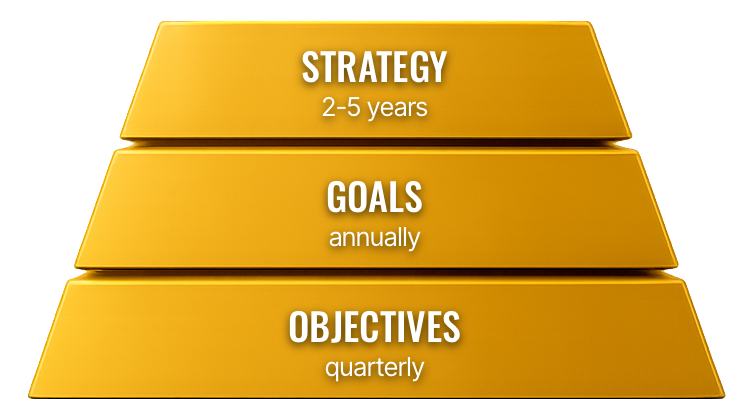
The middle section of the Model represents that transition.
When people ask, “What is our strategy?” they’re often asking because no one has defined a strategy, and if that’s true, then they’re asking the wrong question. A better question is, “How are we going to fulfill our mission?”
That may sound like semantics, but it changes the conversation materially. A strategy isn’t simply a list of initiatives or a collection of projects. It is the organization’s deliberate approach for accomplishing its mission over the coming years. I like to see a strategy span two to five years. Three years is a sweet-spot. Once that strategy is defined, everything beneath it should support that approach.
Goals then build on the strategy by defining the broad outcomes the organization expects to achieve. They aren’t meant to describe every task or every measurement. Instead, they provide meaningful direction for the coming year and create alignment across departments.
Objectives take the next step. If goals describe where the organization wants to arrive, objectives determine how progress will be measured along the way. Good objectives give leadership confidence that the strategy is producing meaningful results instead of simply keeping everyone busy.
These three layers work together:
- Strategy provides direction.
- Goals define the desired outcomes.
- Objectives measure progress.
When one of those layers is missing, the others begin losing their value. I’ve seen organizations with excellent objectives that weren’t connected to any meaningful strategy. Every department achieved its targets, yet the business itself made very little progress because each area had been measuring success differently.
In one situation, I worked with an organization that had a simple mission, which was to have a positive influence on people’s lives. It was a specific group of people, but I’m leaving it nameless and avoiding the actual mission statement because it’s irrelevant to the point. Everyone knew and understood that mission. But the organization never defined a clean strategy, so because of that, their goals were weak, effectively stating “impact more people by year’s end.” Their only measure was the number of people they were helping. That was the only goal. That meant that any initiative that added even just one more person to the customer list was approved, and continually caused competing resources and priorities. Should we focus on the project that helps ten more people? What if another project will help twenty? When the goals are vague, resulting from a lack of strategy, the objectives are set up for confusion, not action.
I’ve also seen organizations announce a strategy without ever defining goals or objectives. Everyone agreed with the direction, but nobody knew whether they were actually getting there, or what was needed to do so. In one case, when asking about a company’s strategy, I was told that it was simply to “grow,” to which I said, “growth is not a strategy, that’s an expected result. I want to know what your strategy is for achieving growth.” I heard some ideas, mostly goals and projects, but I never heard a solid strategy.
Alignment happens when all three aspects work together. This is also how priorities become much easier to establish. When an idea comes up—and most ideas are operational actions like projects, tasks, or deliverables—I always try to connect it back to the chain of objectives, goals, and strategy. If they don’t exist, they need to be defined. Knowing which part of the strategy an idea supports is a surprisingly effective filter.
Projects that clearly advance the strategy move forward. Projects that don’t are postponed, reshaped, or sometimes abandoned altogether. That doesn’t necessarily make them bad ideas. It simply means they aren’t the right ideas for where the organization is trying to go today. They may belong on the list, just a lot further down.
Michael Porter captured this concept well when he wrote:
“The essence of strategy is choosing what not to do.”
I believe that statement becomes much easier to live by once strategy, goals, and objectives are clearly defined. Decisions become less emotional because they can be evaluated objectively against something the organization has already agreed upon.
When priorities seem to change every week, strategy usually isn’t the problem. The problem is that strategy hasn’t been translated into goals and objectives that everyone understands. While purpose gives everyone a reason for contributing and being part of an organization that’s worth following, it’s strategy that actually creates the direction people need to go. Goals create the alignment they all need to avoid internal competition for resources. Objectives create accountability that keeps everyone, everywhere, in check.
Why you exist gives you purpose.
What will you do in fulfillment gives you direction.
Does your organization struggle to define strategy, and set aligned goals and objectives? Check out the Strategy Model for guidance on creating a working strategy with clear goals and objectives that your team can use to prioritize their work.