The Alignment Index
A practical way to determine whether your organization is becoming more aligned over time. Rather than measuring business performance alone, the Alignment Index measures how consistently people understand the organization’s direction, make decisions, prioritize work, and execute toward shared objectives.
Measuring Organizational Alignment
Every organization wants to improve. It isn’t hard to decide whether improvement is important, but whether the changes being made are actually having the intended effect. Teams often rely on intuition, anecdotal feedback, or isolated success stories, but those observations rarely provide a complete picture of how well an organization is functioning as a whole.
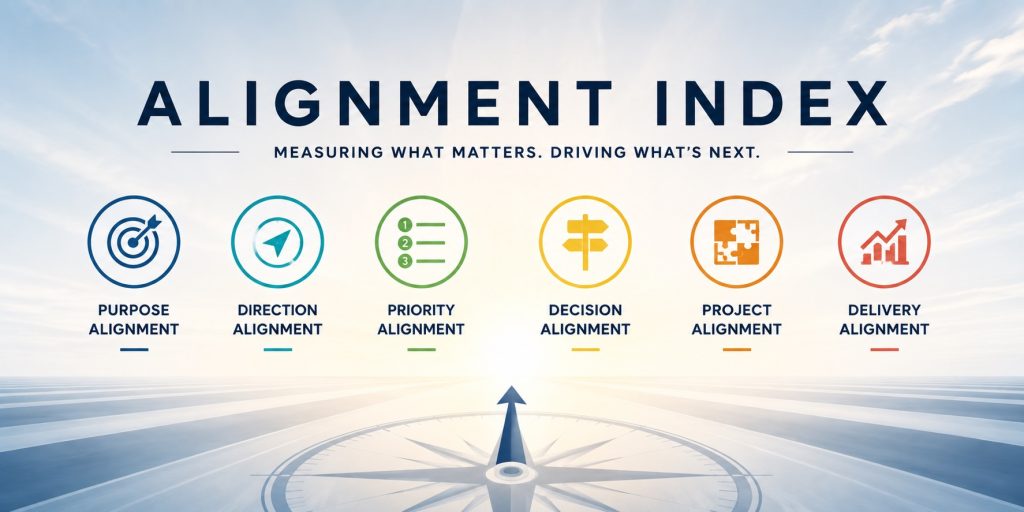
The Alignment Index was created to provide a consistent way of measuring organizational alignment over time, particularly as it relates to the model as shown in the OPSE Model. Rather than evaluating financial performance, employee satisfaction, or operational efficiency directly, it measures how effectively an organization is working together toward a common direction.
The purpose of the Alignment Index is not to judge an organization, but to measure progress over time.
What Does It Measure?
The Alignment Index measures the effectiveness of the organizational systems that guide decisions, priorities, and execution. It is built around the principles established by the Strategic Guidance Framework, the Priority Framework, the CLEAR Process, and the STREAM Process.
The Alignment Index identifies whether people throughout the organization are aligned. Do they understand the direction? Are decisions being made consistently? Are projects supporting the organization’s objectives? Are teams working together toward the same outcomes?
Those questions become considerably more valuable when they are measured consistently over time.
Alignment Dimensions
The Alignment Index is composed of several dimensions, each representing an important aspect of organizational alignment.
Purpose Alignment
Measures whether leaders and employees understand the organization’s values, vision, and mission. Organizations with strong purpose create greater engagement because people understand what the organization stands for, why it exists, and how they contribute to soemthing larger than their individual responsibilities.
Direction Alignment
Measures whether leaders and employees understand the organization’s strategy, goals, and objectives. Organizations with strong direction make more consistent decisions because people understand what the organization is trying to accomplish and where it is headed.
Priority Alignment
Measures whether initiatives are being prioritized consistently against organizational objectives. When priorities remain stable and projects clearly support strategic direction, resources are generally invested more effectively.
Decision Alignment
Measures whether significant decisions have clear ownership, involve the appropriate people, and are communicated effectively. Consistent decision-making creates confidence because people understand not only what was decided, but how the decision was reached.
Project Alignment
Measures whether projects begin with sufficient preparation, remain connected to business value, and continue supporting organizational priorities throughout their lifecycle.
Delivery Alignment
Measures whether teams are able to execute consistently against agreed plans while adapting appropriately as business conditions change.
Together, these dimensions provide a balanced view of organizational alignment without reducing the organization to a single metric.
How It Works
Each dimension is measured through a standardized set of questions answered by the appropriate people within the organization. Depending on the objective, participants may include executives, directors, managers, project sponsors, project managers, or other employees who are directly involved in organizational planning and delivery.
Responses are normalized into individual dimension scores, producing an overall Alignment Index while still allowing each area to be evaluated independently.
The greatest value doesn’t come from the overall score.
It comes from understanding why each dimension received that score.
Example
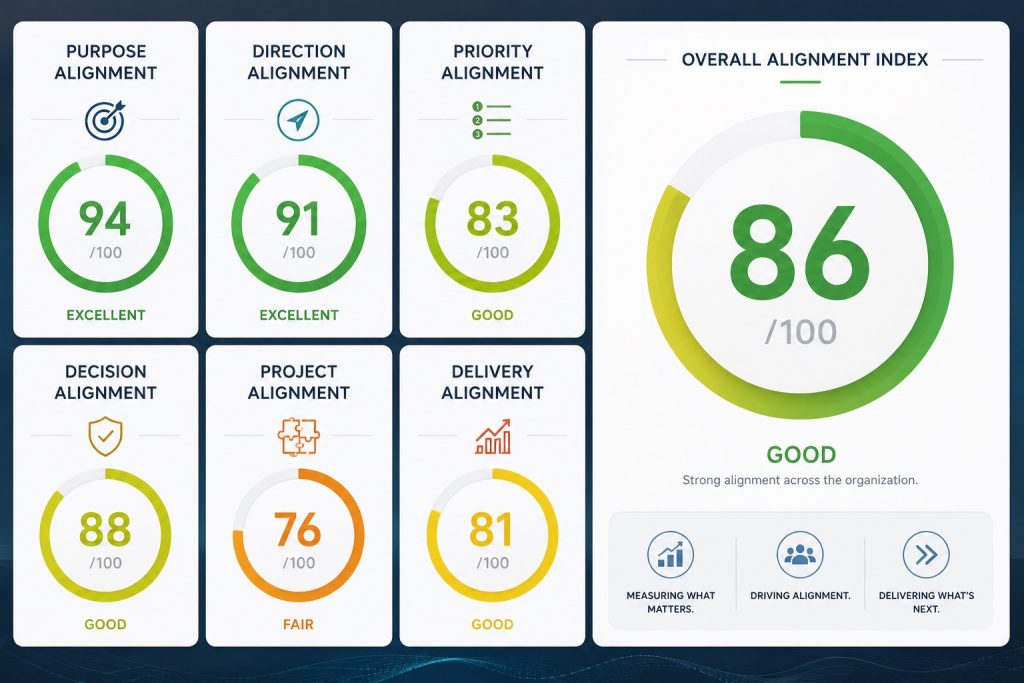
An organization with an overall score of 86 may appear healthy at first glance, but the individual dimensions tell a more useful story. In this example, project alignment represents the greatest opportunity for improvement, suggesting that project selection, planning, or governance may deserve additional attention. Also, purpose alignment is the highest score, suggesting that the organization has engaged, motivated, and aligned people, which suggests that the declining scales of direction and priority are increasingly affecting the lower-level project implementations.
People are engaged, but they are comparatively struggling a little with the direction, struggling more with priority, clear on decisions, but not clear on projects. Thus, projects may be misaligned with priority and direction.
Measuring Progress
The Alignment Index is intended to be measured repeatedly. By comparing results over time, organizations can determine whether improvements in leadership, strategy, prioritization, governance, or project delivery are producing measurable organizational alignment. This creates an objective way to evaluate progress rather than relying solely on perception or isolated performance indicators.
Because every organization is different, the goal is not to achieve a perfect score. In fact, a perfect score is probably an indication of bad data. Your people are not being honest or not understanding what they don’t know. There should always be room for improvement, and the intent is continuous improvement. Every time the strategy changes, goals are moved or redefined, objectives are recast, or leaders and other staff change, you’ll get disruptions in the score. These disruptions are valuable when you can identify the cause, as it tells you which areas of operations need attention for improving your business over time.
An organization that improves from 58 to 74 has achieved something meaningful, even if another organization scores 88. The value of the Alignment Index lies in measuring progress against an organization’s own baseline while identifying the areas most likely to benefit from continued attention.
Ultimately, alignment is not created by measurement alone.
It is created by consistently defining direction, making deliberate decisions, prioritizing meaningful work, and executing with purpose. The Alignment Index simply provides a practical way to measure whether those efforts are having the intended effect.