
One of the easiest mistakes an organization can make is assuming that once strategy has been defined, execution will naturally follow. It rarely does.
Most organizations don’t struggle because they lack capable people. They struggle because capable people begin solving problems independently without a shared understanding of how today’s work contributes to tomorrow’s direction. Everyone is busy. Everyone has good intentions. Everyone is making progress. The difficulty is ensuring that everyone is making progress toward the same destination.
That is the purpose of the final section of the OPSE Model. It answers one simple question: How will the organization do its work?
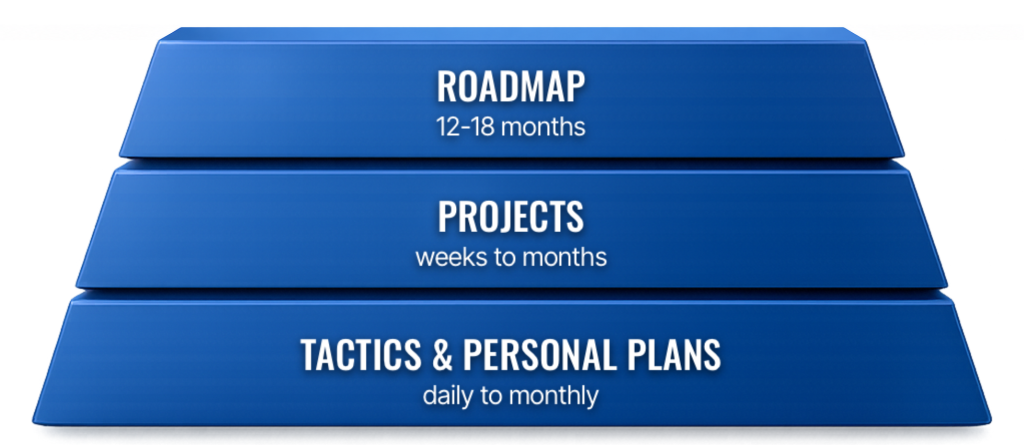
This section consists of three layers: roadmaps, projects, and tactics. Each serves a different purpose.
The roadmap is the organization’s view of the journey ahead. It identifies the major initiatives required to achieve the goals that support the strategy. Unlike a project plan, a roadmap isn’t concerned with every task or every deadline. Its purpose is to answer a broader question:
“What needs to happen, and in what general order, for us to accomplish our strategy?”
That distinction is important because organizations rarely execute one project at a time. They execute dozens, sometimes hundreds, of initiatives that compete for the same people, budgets, and attention. A roadmap provides the context that allows those projects to be planned together instead of independently.
Projects come next. These are where ideas become organized work. They bring together people, resources, schedules, budgets, and deliverables around a specific objective. Good projects have clear outcomes, defined scope, and measurable success. More importantly, good projects exist for a reason. They advance the roadmap rather than competing with it.
I’ve often said that projects shouldn’t be approved simply because they’re good ideas. Even more so, I’ve noted that projects shouldn’t be approved just because they could “make us a million dollars.” They should be approved because they’re the right ideas, supporting the goals, and fulfilling a strategy. If the idea that a project has high potential for sales, reduced expenses, or some other benefit, is all it takes to get a project approved, you’re going to end up with perpetually competing resources. Someone will game the system, and just increase the potential earnings. Using a prioritization framework can significantly reduce that potential conflict.
The final layer consists of tactics and personal plans. This is where the strategy becomes personal, and everyone has a part. Every email answered, every customer served, every line of code written, every proposal reviewed, every sales call made, and every process improved contributes to something larger than the task itself. When people understand how their individual work supports the projects, how the project advances the roadmap, and how the roadmap fulfills the strategic direction, daily work begins carrying much greater meaning.
Organizations often ask whether employees understand the strategy. That’s certainly important, but another question may be even more revealing:
“Can people explain how today’s work contributes to it?”
If they can, the OPSE Model is doing exactly what it was designed to do.
If they can’t, the answer won’t be found in another status meeting or a rallying cry at a Town Hall. Rather, it is often a conversation that reconnects the work being performed to the direction established above it. This is a core reason why I love to think beyond individual projects and into the broader strategy. Projects have a beginning and an end. Roadmaps evolve, and change with seasons or market conditions. Tactics may change daily. But the organization’s direction should remain consistent.
This section of the pyramid in blue represents the flexibility that’s needed to keep the organization on the right path. When projects change, people need to feel connected to the broader strategy and goals. Without that, every change will feel chaotic, deflating, and disappointing. But when there is consistency in strategy, goals, and objectives, the flexibility needed at this operational level is encouraging for staff because it means the flexibility has purpose, and that’s one of the greatest strengths of the OPSE Model. Organizations can change what they are doing without constantly changing where they are going.
Ultimately, people will stop asking, “What should I be working on?” They’ll already know, because the organization has given them something far more valuable than instructions.
It has given them direction, and that direction gives them freedom to act.