Strategic Objectives Method
Organizations that know where they want to go and what they hope to accomplish this year, may still struggle to determine whether they’re actually making progress along the way. The Strategic Objectives Method helps leadership define meaningful checkpoints that provide evidence the organization’s annual goals remain achievable. It focuses on the results that demonstrate the work is having the intended effect, rather than on the work being performed.
While an annual goal defines an organizational commitment, objectives provide the evidence that commitment remains on track.
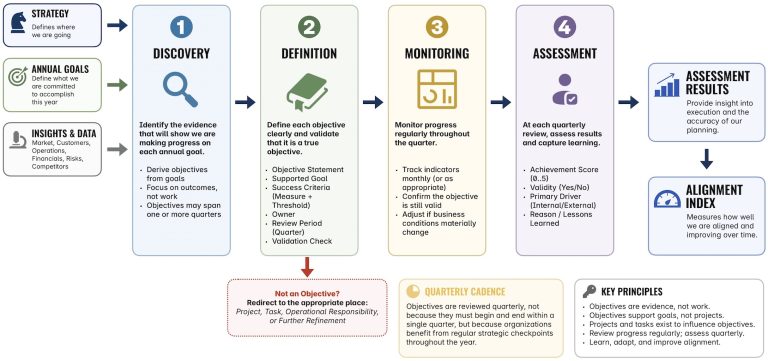
Like Goals, there is one principle at the heart of this method:
An Objective is evidence that the work is producing the intended result, not work to be completed.
This distinction is important because organizations frequently confuse projects with objectives or even goals. “Implement a new CRM” is a project. “Migrate 80% of active customers into the CRM by the end of Q3” is an objective. The project exists to influence the objective. The objective demonstrates whether the project is producing meaningful organizational progress.
Objectives are reviewed quarterly, not because they must begin and end within a single quarter, but because organizations benefit from regular strategic checkpoints throughout the year. Some objectives may span several quarters. Some may be defined with quarterly progressions. Others may be achieved quickly, shorter than a quarter. The important part is that leadership regularly confirms the organization is still moving toward its annual goals.
Step 1: Discovery
Objectives are discovered from goals. For each annual goal, leadership should identify the evidence that would demonstrate meaningful progress throughout the year. Some goals may require only one or two objectives, while others may require several that build upon one another across multiple quarters.
Objectives should never describe work. They should describe measurable organizational outcomes that indicate whether the work being performed is advancing the goal.
For example:
- Goal: Increase annual sales by 20%.
- Possible Objectives:
- Launch the commercial sales program by the end of Q1.
- Increase qualified sales opportunities by 30% by the end of Q2.
- Achieve 10% revenue growth by the end of Q3.
The projects required to achieve these objectives may come from Sales, Marketing, IT, Operations, or any other department. Those operational activities belong elsewhere. The objectives simply describe the evidence leadership expects to see.
Step 2: Definition
Each objective should be documented using a consistent structure.
- Objective Statement
- Supported Goal
- Success Criteria
- Owner
- Review Period
- Validation
Success Criteria should define both what is being measured and the threshold that constitutes success. The measure criteria that defines success, while the threshold what actually constitutes success. For instance, if a company intends to increase sales by 250 units, then the measure is “250 units of increased sales.”
Example
Objective Statement: Increase qualified sales opportunities by 5% by the end of Q2
Supported Goal: Increase annual sales by 20%
Success Criteria Measure: 150 new sales potential accounts
Success Criteria Threshold: 10% variance (135 or more is “materially met”)
Owner: Vice President, Sales
Review Period: Quarter 2
Validation: … (see below)
Validation
Before an objective is accepted, it should pass a simple validation.
- Does it directly support an annual goal?
- Does it describe evidence of progress rather than work to be completed?
- Does it define clear Success Criteria?
- Can it be reviewed during the year?
- Is there a clearly identified owner?
If the answer to any of these questions is no, it probably isn’t an objective. It may instead be a project, a task, an operational responsibility, or simply an idea that requires further refinement.
Success Criteria
Success criteria has the potential to be vague or imprecise. When a business identifies that it wants to increase sales by 20% it typically means 20% more revenue. If that is the goal, then several objectives could be defined:
- Raise prices by 20%
- Increase volume of sales per customer by 20%
- Increase the number of buying customers by 20%
- And so on, and any variations of the above
Presume Sales decides to increase the number of buying customers and sets that as the objective. If the business currently has 10,000 customers but has 20,000 potential customers, so that the potential-to-actual ratio is 2:1, this also means 4,000 new potentials will bring 2,000 customers, meeting the 20% goal.
Sales already secured 500 new converted customers in Q1, which is 25% of the target, so for Q2, Sales sets an objective to increase sales opportunities by 5% for the quarter, and defines the Success Criteria Measure to be “1,000 new customer potentials.” This would yield 500 conversions in Q2, still meeting the goal. However, 1,000 potentials is the measure, but for the quarter, 500 conversions is the real intent. Therefore, the threshold could be stated as “Average customer buys $100 annually, 500 buying customers is $50,000; threshold is $50,000 by any means.” This means that if the business gets only 800 new potentials, but the resulting 400 converted customers are spending $125 each on average, that’s still $50,000.
This is the case where the measure is a specific number, but the threshold represents a material success. A business can fail to hit the measured target, but still achieve the intended result. In the Assessment step below, this the condition for identifying “materially met” to qualify success even when the precise measure isn’t hit.
Step 3: Monitoring
Objectives should be monitored regularly throughout the quarter rather than waiting until quarter-end to determine whether they succeeded. Leadership should review progress, identify emerging risks, and determine whether the objective continues to represent the right evidence given current business conditions. Changes in market, competition, or legislative factors, may materially affect an objective, so it may be appropriate to revise the objective while keeping the annual goal intact.
Generally, goals should remain relatively stable throughout the year. When a Goal can’t be met, it should move back into the backlog for future delivery, but still remain as a goal. Objectives, on the other hand, provide the flexibility needed to respond intelligently to changing conditions without abandoning the organization’s strategic commitments. This means that some objectives may be dropped, or changed, and new ones may be added. Objectives do not go into a backlog like goals. Since objectives need to meet a goal, they either exist, or they don’t. A changed objective is simply a new objective at a new time, and the old one is dropped.
Step 4: Assessment
At each formal quarterly review, every objective should be assessed using a consistent approach.
Record an Achievement Score.
- 0 — Not Met
- 1 — Immaterially Met (met, but not enough to matter)
- 2 — Materially Met (met enough to matter)
- 3 — Met
- 4 — Exceeded
- 5 — Significantly Exceeded
Then record whether the objective remained valid.
- Yes
- No
Finally, identify the primary driver influencing the outcome.
- Internal
- External
A brief explanation should accompany each assessment to capture lessons learned and provide context for future planning.
These assessments become valuable organizational knowledge. Over time they help leadership understand not only whether objectives were achieved, but whether the organization is consistently defining the right objectives in the first place. This information also provides meaningful input into the Alignment Index, helping measure whether the organization is becoming more aligned over time.
For an achievement score of 1 or 2, the idea of immaterially or materially met is a bit subjective to the organization. Rather defining a percentage threshold, this provides a tipping point from “not met” to “met.” Not met means nothing moved the needle on that objective. Zero work effort, zero success, zero movement. But completing part of an objective’s target may still mean “not met,” and depending on the type of objective, 1% to 49% may be immaterial, or 1% to 99% may be. If the objective is a sales increase target, any percentage greater than zero and less than the target may be materially met. For a compliance objective, there may be a legal requirement for 80% compliance, making 1-79% immaterial, and 80-99% is material, and 100% is met. Organizations should determine what the tipping point is that declares whether the success measure is materially met.
From Commitments to Evidence
The Strategic Objectives Method transforms annual goals into measurable evidence that leadership can review throughout the year. By separating objectives from projects and focusing on outcomes rather than activities, organizations gain meaningful insight into whether their strategy is progressing as intended.
Goals define what the organization has committed to accomplish.
Objectives demonstrate whether those commitments remain achievable.
Projects and day-to-day work then become the means of influencing those objectives, allowing leadership to focus on organizational direction while delivery teams focus on execution.