The STREAM Process
Great ideas are easy to find. Turning them into successful projects is considerably harder.
Most organizations have no shortage of requests. New ideas arrive from customers, managers, executives, employees, and vendors every week. Some solve real problems, others promise exciting opportunities. Many deserve discussion, but very few deserve becoming projects.
The challenge is deciding which is which. Without a consistent process, organizations often approve projects because they sound interesting, because someone influential (or loud) requested them, or because they simply feel urgent. Those same organizations later find themselves questioning budgets, revisiting priorities, and wondering why so many projects compete for the same resources.
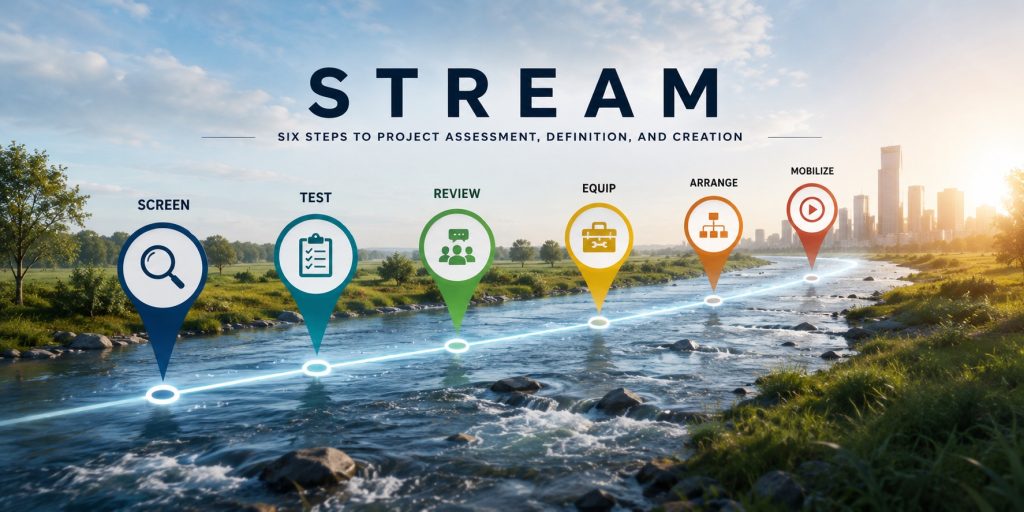
The STREAM Process provides a practical way of moving an idea from conversation to execution. It isn’t intended to replace governance or project management, and in most cases should complement the expectations of an organization’s PMO (project management office) or CAB teams (change advisory board). Instead, it helps organizations ask the right questions before significant effort has been invested.
Screen
Every idea deserves a fair hearing. Not every idea deserves a project. The first step is simply determining whether the idea is worth exploring further.
Ask:
- Does it solve a critical problem or fulfill a genuine business need?
- Will it deliver measurable benefits?
- Can those benefits be repeated or expanded over time?
Before moving forward, verify one final thing.
Is the sponsor willing to gather objective information to support the idea?
If the answer is no, the idea probably isn’t ready yet. Having the sponsor take time to gather objective information at the onset helps to address situations of “over the wall” requests. An “over the wall” request is something we referred to years ago in software development, as being a request that someone printed off, and tossed over the cubicle wall for someone else to solve. The Candid Startup identifies this as an “Organizational Anti-Pattern“, and it’s all too common. Encouraging people to do their own leg-work ahead of time is one of the effective methods of screening incoming requests. Not everything needs to be accepted.
Not sure if your data validates these questions? Check out The Data Factor.
Test
Ideas often sound stronger in conversation than they do on paper. People may have a “gut feel” on the legitimacy of a project. But those people may not be around when it comes to fruition, so it helps to ensure there’s clarity and not just a general acceptance. The Test stage forces clarity by applying the SMART criteria model.
Is the proposal:
- Specific?
- Measurable?
- Actionable?
- Realistic?
- Time-bound?
By the end of this step, there should be enough information to answer one practical question.
Is this worth the organization’s time?
If it is, then it’s acceptable for additional subject matter experts (SMEs) or leaders to allocate time to gathering information and helping to build a strategic business case (SBC) or a request for proposal (RFP). (Other common starting documents, depending on your organization, may include a Project Proposal, Project Brief, Pitch Deck, Project Charter, or a Feasibility Study).
Review
The review phase is a turning point, and it’s where ideas become candidates for actual investment. Time spent until now is research time, usually bundled into some form of administrative capacity. After this phase, it’s a viable project idea (presuming it hasn’t been rejected). Using the Priority Framework, the project is evaluated against four typical categories:
- Strategic Alignment
- Operational Impact
- Feasibility
- Financial Value
The purpose is to evaluate every proposal consistently so that priorities are defined according to organizational value rather than personal preference. At the end of this stage, leadership should be able to answer one question with confidence.
When should this project be done?
The beauty of the Priority Framework is that it serves an objective guideline for sequencing, allowing your roadmap to be built upwards from projects ideas just as much as it’s built downwards from strategy, goals, and objectives. This is also why roadmaps are part of tactical operations, while spanning multiple objectives and goals. (See the OPSE Model.)
Equip
Once a project has been approved and prioritized, at some point, it will reach the time where pre-planning is needed. You may not have a full project plan, but you likely have some variation of a charter or enough of a one-page definition to start building the project. To do that, you need dedicated resources to allocate time building out the broader project specifications. Identify the executive sponsor, assign a project manager, and involve the subject matter experts who will contribute throughout the project.
Just because people are available doesn’t mean the project will succeed. But they have the highest chance of succeeding if you ensure that the right people are also engaged at the right time.
Build out your detailed project plan. This may be a waterfall-style implementing (big planning up front, long-term implementation) or agile-style (just-in-time design and implementation, adapting to changing conditions on the way).
This should allow you to confirm:
Who should be involved in any aspect of this project?
The one thing you can’t afford at this point is to equip your project with the wrong people. At this point, you now have a plan ready for when the project is reaching its starting point, and all resources are allocated.
Arrange
Just before work begins, establish the structure that will support your project’s delivery. Define the major deliverables, establish a realistic timeline under the present circumstances and resource availability, identify any remaining significant risks, and determine how those risks will be managed if they occur.
Good planning doesn’t eliminate uncertainty. It prepares the team to respond to it.
Your goal in arranging the team is to make sure you’ve validated everything you’ve estimated along the way. Your initial approval may have been dependent on unknowns that are now resolved when you equipped the team. Environmental or market conditions may have changed some factors. Getting everything arranged before you begin helps to ensure the entire team is ready before the work time is allocated.
The result is that you should be able to answer:
How will we deliver this project?
Mobilize
When your project is ready to begin, and you’ve done everything you can to stand, then stand. By this point, the project has been already justified, prioritized, staffed, and planned. The team understands why the project exists, what success looks like, and how the work will be organized.
Implementation becomes the natural next step rather than the first step, and your team is now mobilized to get the job done.
Whatever project management method you use from this point forward, is at your discretion. These steps help to ensure that you had clarity from the initial idea so that execution can be a raging success.
You should be able to identify:
When does this project begin and end?
From Idea to Execution
The STREAM Process is intentionally sequential. Each stage answers a different question before the next begins.
- Screen: Is this worth exploring?
- Test: Is the idea well-defined?
- Review: Does it deserve priority?
- Equip: Who will deliver it?
- Arrange: How will it be delivered?
- Mobilize: When do we begin?
Organizations often rush toward execution because that’s where visible progress occurs. STREAM encourages thoughtful decisions before significant investment begins.
The result is fewer surprises, stronger alignment, and projects that begin with a much clearer understanding of why they exist and what success should look like.