
OPSE Model
This page is for leaders who feel as though their organization is busy, capable, and full of good ideas, but still struggling to move in a clear direction. If projects compete for attention, priorities keep shifting, or teams seem to be working from different assumptions about what matters most, the issue may not be effort. It may be guidance.
Imagine walking into your office on a typical Monday morning. Before you’ve had a chance to settle in, someone wants to discuss a new project idea they came up with over the weekend. Another person has an idea for improving a process. A department manager needs additional budget, IT wants to replace a system, Sales has an urgent customer request, Finance needs new reporting, and Operations believes another initiative should take priority.
None of these requests are unreasonable. In fact, most of them probably have merit. The challenge is that every conversation sounds important, or at least the person bringing it forward believes it is. As a leader, you’re expected to listen, evaluate, and decide which ideas deserve attention and which ones can wait.
As the day progresses, more conversations take place. Meetings generate action items, emails continue arriving, and decisions are made as new information becomes available. By the end of the day, everyone has been busy and a great deal of work has been accomplished, yet there’s still a lingering feeling that the organization isn’t moving forward with the kind of purpose everyone had hoped for. Instead, it feels as though the business has simply become better at responding to whatever happened to appear in front of it.
For a lot of leaders, this can manifest with phrases like, “we have so many competing priorities!” or “what on earth are we supposed to be focusing on?” If that sounds familiar, you’re not alone.
Many organizations eventually find themselves asking these questions regularly, whether out loud or through silent suffering in their own minds:
- What is our strategy?
- Which projects should we be working on?
- Why do our priorities keep changing?
- Why does every department seem to have a different understanding of what’s important?
- How do we know if we’re investing our time in the right things?
Those are great questions, but they usually aren’t the first questions that need to be answered.
When an organization struggles with strategy, the instinct is often to schedule a strategic planning session. When projects begin competing for resources, a prioritization meeting follows. When teams seem disconnected, new communication processes are introduced. Sometimes those efforts help. More often they simply reorganize the confusion.
Over the years, we’ve found that organizations experiencing these symptoms are often missing something much simpler: they lack guidance. Not guidance in the sense that people don’t know how to do their jobs; most organizations are filled with capable people who genuinely want to contribute. The missing guidance is directional.
People don’t always understand where the organization is ultimately trying to go, why that destination matters, or how today’s work contributes to it. Without that understanding, every department naturally begins making good localized decisions. Unfortunately, good localized decisions don’t always add up to a good organizational direction.
That observation leads to what we call the OPSE Model: Organizational Purpose, Strategy, and Execution.
Its purpose is simple: to provide a practical way of connecting an organization’s Purpose to the Strategy and Execution work that is performed every day.
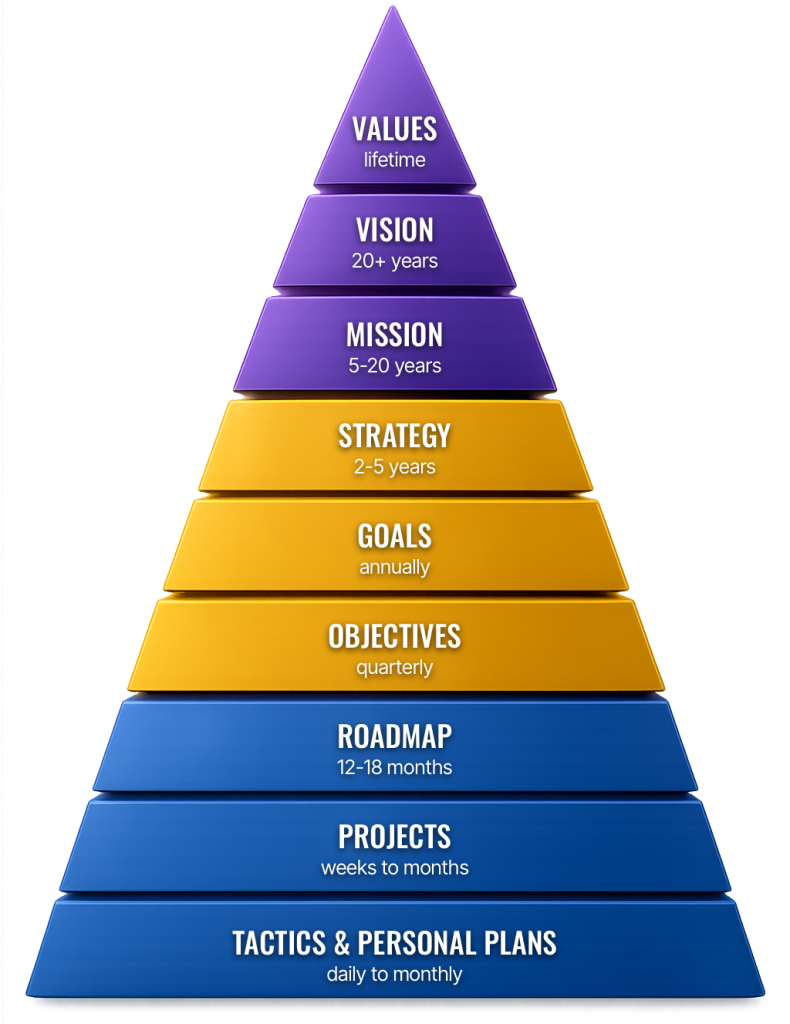
Don’t think of this as a pyramid in a construction sense, where the base is the foundation, and everything is built on top it. Instead, the model represents influence and effort magnitude, rather than construction. The smallest section at the top has the greatest influence over everything beneath it—a guiding direction if you will. Values influence vision; vision shapes mission; mission informs strategy, and so on. In other words, the framework is defined from the top down, and that’s how you lead.
Daily work flows in the opposite direction. Teams execute projects, projects advance the roadmap, the roadmap achieves objectives and goals to fulfill a strategy, all ultimately in service to the company’s mission, vision, and values.
That relationship is what makes this model useful. When an organization begins experiencing confusion, the model provides a way to trace the symptoms back to their source. If any one of these points feels unclear—projects, objectives, goals, strategy, mission—look to the item above it to see if there is clarity. If projects don’t seem valuable, examine the roadmap. If the roadmap feels chaotic, examine the objectives and goals. If strategy is unclear, look at the mission.
Questions will naturally move upward, while direction and leadership moves downward.
Most organizations try to solve problems where they first become visible. The OPSE Model encourages leaders to keep asking why until they reach the layer that actually needs attention.
The model is also organized into three sections, addressing Why (Purpose), What (Strategy), and How (Execution) to operate.
Purpose: Why the Organization Exists
The top section answers why the organization exists.
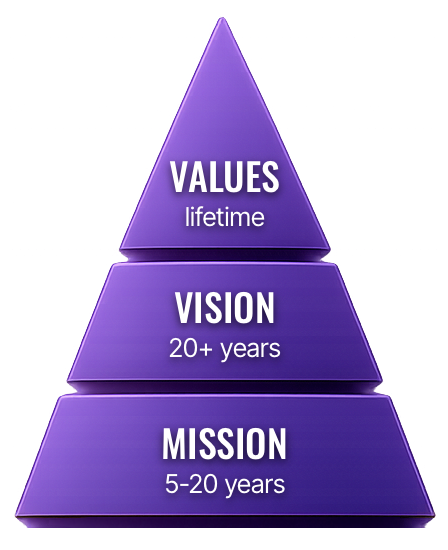
Values define who the organization chooses to be. They represent its ethics, principles, beliefs, and culture. These should be timeless! They exist as long as your organization exists. Vision explains why the organization exists and the future it hopes to create. Mission describes what the organization intends to become and the role it wants to play in the world.
Those three elements rarely change quickly. They provide long-term direction for every decision made beneath them.
These three together are defined by the leaders in the organization. This may be the shareholders, the board, the President or CEO, or the top level executives, directors, or C-suite leaders. They are the first people to adopt the company’s direction, the first to promote it, and the last to abandon it.
This top section, representing why the company does what it does, becomes the guiding principles of the company.
Strategy: What the Organization Intends to Accomplish
The middle section answers what the organization intends to accomplish.
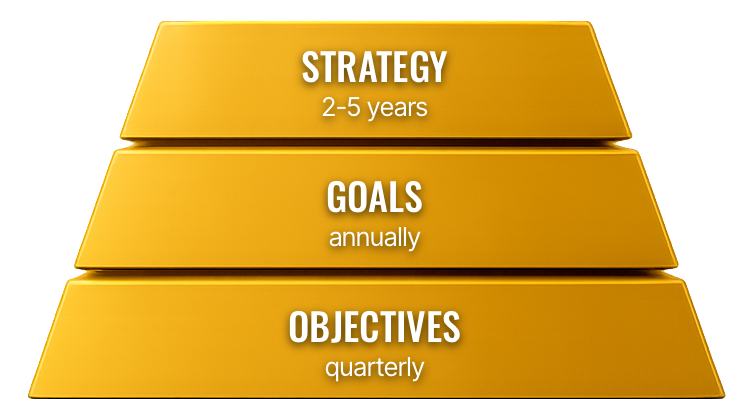
Strategy defines the practical approach for achieving the mission. A good strategy should last two to five years, as this would represent a common cycle of market changes and conditions. If it changes more frequently, it’s either objectives and goals that are actually changing, or, the company is simply not focused on the mission. Goals describe the broad outcomes the organization hopes to achieve, typically set annually, and tied to the annual budget. Objectives establish measurable targets that demonstrate progress within the annual goals and budget decisions.
This is what allows direction to become actionable. All of the leaders of the organization should be in alignment on the strategy, goals, and objectives. If they are not aligned, the problem identified earlier begins to surface, and departments or leaders will be competing for priorities and resources. When leadership is aligned on these sections, everyone works towards the same targets, for the same reasons.
This middle section, representing what the company does, becomes the strategic direction of the company.
For guidance building a strategy, goals, and objectives for your organization, see the Strategic Guidance Framework.
Execution: How the Organization Will Do Its Work
The final section answers how the work gets done.
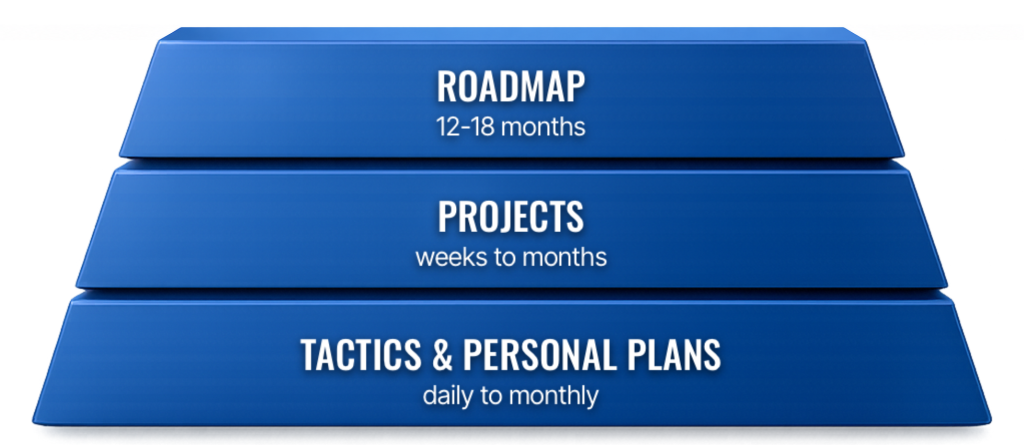
The roadmap identifies the major initiatives required to achieve the objectives and goals. Projects organize that work into manageable efforts. Tactics and personal plans represent the work performed every day by individuals and teams across the organization.
Note that the roadmap may span a timeframe that is longer than the objectives (quarterly) or the goals (annually). This is because roadmaps are not set in stone and may change if market or environment conditions change. But more importantly, when implementing projects, companies should never treat individual projects as standalone elements exclusively. Often, projects will compete for the same resources. Projects may change when new ideas come up. Projects may need to be planned well in advance of their implementation, and especially when those projects are interconnected, like a software development project, knowing more information about future projects helps to ensure that current projects are designed and implemented correctly. The roadmap is a vision of the intended projects, scheduled and mapped on a timeline even if it spans future periods or years, to ensure that current projects do not act unilaterally and deviate from the objectives and goals. They should, in fact, be in fulfillment of them.
This section is where most organizations spend almost all of their time, and represents its daily operations. It’s also the section that typically has the most confusion, the most number of people not aligned with the business, and the most competition for finite resources.
However, it becomes much easier to manage once the layers above it have been clearly defined.
This bottom section, representing the magnitude of work in the company, becomes the company’s operational behaviors.
For guidance preparing a roadmap, projects, and personal plans, see the Priority Framework.
The OPSE Model isn’t intended to replace strategic planning, project management, or operational excellence. But it does connect them. In its simplest implementation, this model can act as a checkbox of requirements an organization should have when any of the items on the pyramid are struggling. If your company is struggling with project priorities—the most common issue I’ve encountered—this model helps to trace the cause, rather than to try to treat the symptom.
If you have competing projects, the solution isn’t to implement a new project management system. The solution is to look upward to your roadmap. If you don’t have one, that’s the first problem. Look a level higher, at your goals. Are they defined quarterly, or even at all? If not, that’s the second problem. Look higher, to your objectives. Are they defined for your fiscal year? Keep going until you find the layer that is well-defined and well-understood in your company. Make sure that layer is communicated with clarity. Then move down a level, and put your first efforts there.
When people understand why the organization exists and align with its guiding principles, what it is trying to accomplish and support its strategic direction, and how their work contributes to that purpose in operational behaviors, decisions become easier to make. Priorities are easier to defend. Projects become easier to justify. And the result is that teams begin pulling in the same direction because they understand the destination before they begin the journey.
Everything starts with guidance.
Everything else follows from there.