
If you’ve ever finished a day exhausted only to wonder what you actually accomplished, you’ve probably been experiencing the “tyranny of the urgent.” This is a phrase first coined in a 1967 booklet by Charles E. Hummel, which cites this as a condition where things that are urgent get attention, regardless of whether that thing is important or meaningful. It’s a trap that’s easy to fall into. Emails arrive. Phones ring. Someone stops by your office with “just a quick question.” Before long, the day has disappeared, and the work you intended to accomplish is still sitting exactly where you left it yesterday.
The challenge isn’t that urgent work exists. Some things genuinely require immediate attention. The challenge is allowing urgency to become the default way of operating. This can be reflected in individual activities, but it also has broader implications in project planning and decision-making, because it’s equally easy to give attention to projects and initiatives that seem urgent even when they aren’t important. Solving it at a company-wide level, however, usually requires individuals to solve it at a personal level first.
Former U.S. President Dwight D. Eisenhower recognized this distinction long before email and smartphones complicated our lives. His decision framework, now commonly known as the Eisenhower Matrix, separates work into four categories based on whether it is important and whether it is urgent. The goal is to protect the work that creates the greatest long-term value.
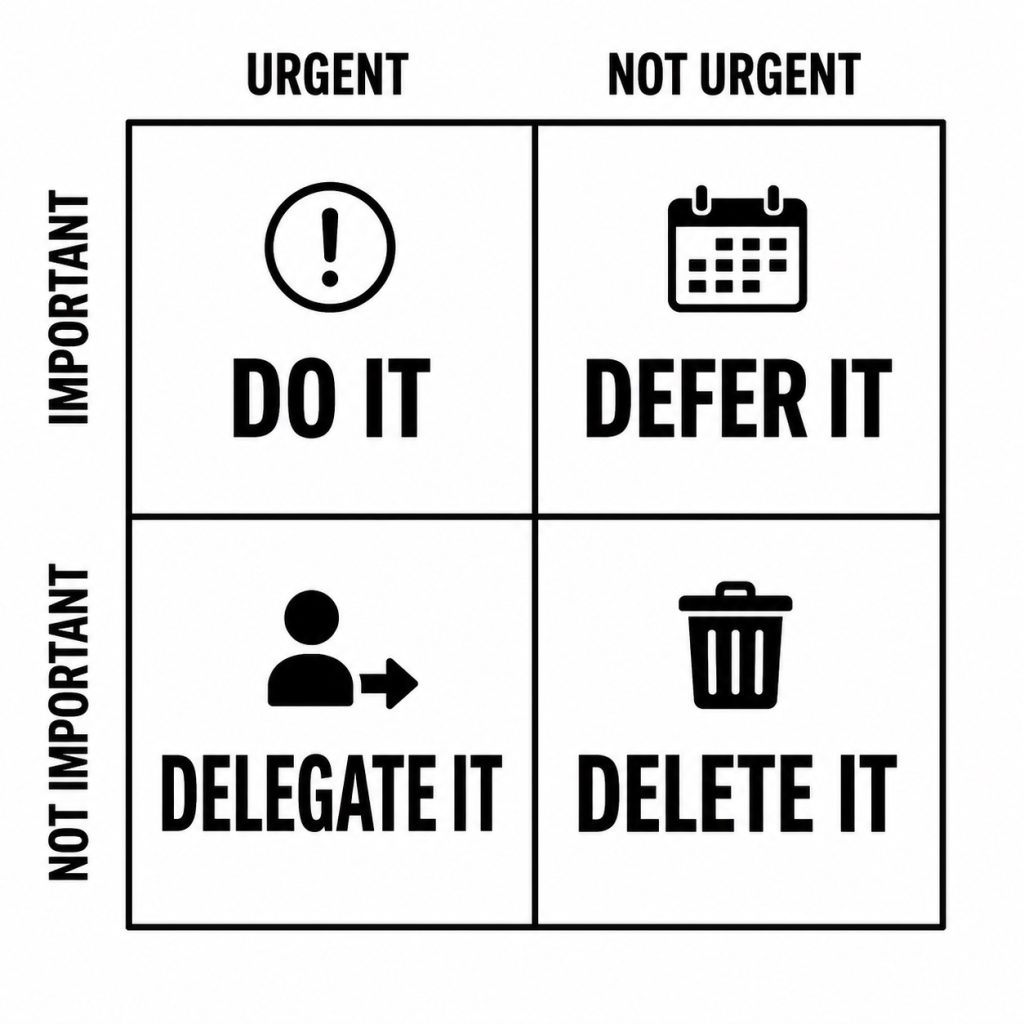
Stephen Covey later popularized the framework in The 7 Habits of Highly Effective People, encouraging leaders to spend more of their time in Quadrant II: work that is important but not yet urgent (the upper right quandrant). The two left quadrants are stressful; you only want to live there when you have no choice. Pro tip: very few things actually give you “no choice.” More often than not, you are the reason you’re living there. The bottom right quadrant is irrelevant, and it doesn’t need your attention. Living in Quadrant II is where your work is bringing value, but you are not under the tyranny of the urgent.
That quadrant deserves more attention than it usually receives. Strategic planning lives there. Building relationships lives there. Improving processes lives there. Learning new skills lives there. Unfortunately, so does everything we keep promising ourselves we’ll get to “when things settle down.”
Things rarely settle down.
One of the reasons people remain trapped in urgency is that they know something is important, but they haven’t decided what to do with it. That’s where David Allen’s Getting Things Done complements the Eisenhower Matrix remarkably well. Allen encourages us to make a decision every time something captures our attention. Rather than carrying it around mentally, decide what happens next:
- Do it.
- Defer it.
- Delegate it.
- Delete it.
I like the simplicity of that approach because it forces movement and decision. Every incoming request receives an intentional decision instead of becoming another item occupying valuable mental space. Combined together, these two frameworks create a practical way to think about work.
First, determine whether the work is important or simply urgent. Then decide what action it deserves. An urgent request that isn’t important may be delegated or declined. An important task that isn’t urgent should be scheduled (deferred) before it becomes tomorrow’s emergency. Something that requires only a few minutes can often be completed immediately (do it). Something that adds little value may simply be deleted.
That process takes only a few seconds, yet it prevents many hours of reactive work later.
I’ve noticed that organizations often struggle with the tyranny of the urgent for the same reason individuals do: every request arrives marked “High Priority.” Every customer issue feels critical, because we “might lose them if we don’t respond now.” Every project claims to be the most important initiative of the quarter. Eventually, urgency loses its meaning because everything has been labeled urgent.
As the saying goes, if everything is urgent, nothing is.
That isn’t just a clever phrase. It’s a practical limitation. People, budgets, and attention spans are finite. Declaring everything important—or worse, declaring it urgent—doesn’t create more capacity. It only spreads the existing capacity more thinly. The more urgency is applied to activities, the higher the stress for the people acting on them, and eventually that stress breaks your resources.
Escaping this tyranny requires discipline. It means protecting time for work that matters before urgency forces your hand. It means becoming comfortable saying, “not yet,” when something doesn’t support today’s objectives. It also means recognizing that every interruption deserves a decision, not an immediate reaction. When you have only four decisions to choose from, the reaction element is no longer an issue. Can you do it in two minutes? If so, go ahead. If not, your only decision are defer it, delegate it, or delete it. That means saying “thanks, I’ll schedule it. Bye,” or “I’m not able to do this, I’ll pass it to Fred. Bye,” or “I’m sorry, this can’t be done, I need to respectfully decline. Bye.”
Urgency will always exist. You don’t need to try to eliminate it, you just need to manage it with a consistent approach to ensure that urgency no longer decides your priorities for you.
The best leaders I’ve worked with aren’t the ones who respond to everything the fastest. They’re the ones who consistently make time for the work that prevents tomorrow’s emergencies from happening in the first place.